

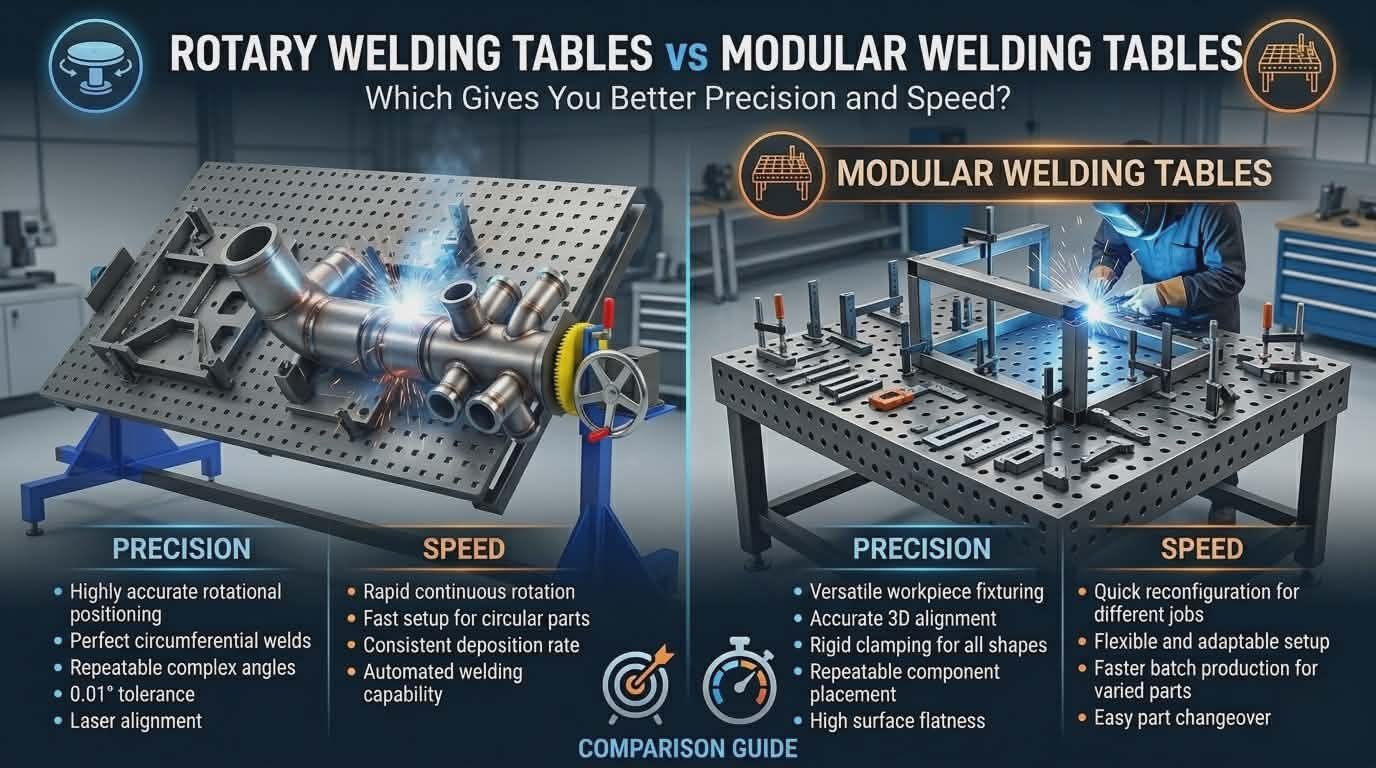
What’s the Article Talking About? This article helps fabricators and shop owners understand the core differences between rotary welding tables and modular welding tables, so they can make a confident, informed purchase decision.
Well, there are two types of welding tables that we are going to talk about in this write-up. Choosing the wrong welding table doesn’t just slow down your progress but also chips away at your precision and margins. So, whether you opt for a rotary welding table, a rotary welding positioner, or a modular welding table, getting the decision right is of the utmost importance. Not just an investment, but it is also one of the smartest investments for a fabrication shop.
What Is A Rotary Welding Table
A rotary welding table or rotary welding positioner is a powered and manually driven platform that helps to rotate the workpiece continuously while the welder stays in a fixed position. So, instead of you moving around every time to move the part, the part itself moves around you, making it convenient and work-efficient.
The welding rotary table has proven to be a game-changer, especially for cylindrical and symmetric work. Pipes, tanks, shafts, pressure vessels, and flanges can all be worked upon with the rotary table. Therefore, such a table can consistently control travel speed for uniform bead quality, reduce welder fatigue, and provide a compact footprint that suits tight shop floors.
What Does A Modular Welding Table Do
It is a flat, grid-patterned steel surface with a matrix of holes or slots. It is designed to accept a wide range of clamps, stops, squares, and other fixtures, built on a custom jig directly on the table’s surface. You need to just lock your workpiece into position and weld!
The most defining advantage of such a table is its work flexibility. The same table that supports a square frame today can be easily adapted for a complex multi-part assembly tomorrow. That is also without buying any new equipment. Therefore, opting for a good modular table, like that from Fixto’s extensive collection, will deliver a repeatable part positioning across production workflows, quick reconfiguration, and a flat reference surface that keeps assemblies square and genuine.
Which One Is Better: A Rotary Welding Table Or A Modular Welding Table
| BASIS OF DIFFERENCE | ROTARY WELDING TABLE | MODULAR WELDING TABLE |
| Purpose | The table rotates the workpiece continuously. This helps the welder hold a fixed position, eliminating the need to manually reposition heavy or awkward cylindrical parts mid-weld | Such a table provides a rigid, grid-based flat reference surface where parts are clamped into custom fixture setups. This ensures every component sits in exactly the right place before the arc even strikes |
| Precision mechanism | Precision comes from motorised rotation delivering a consistent, controlled arc. It removes human hand-speed variation, which is the primary cause of uneven bead width and inconsistency. | Precision comes from the fixture itself, clamps, stops, and squares that lock parts to the grid so that positional accuracy is built into the setup, not dependent on the welder’s eye. |
| Speed | The table eliminates the stop-reposition-restart cycle on circumferential welds. Once the part is chucked and rotation begins, welding is continuous and uninterrupted. | Speed payoff is back-loaded. Initial fixture setup takes time, but once a jig is dialled in, documented, and stored, repeat jobs run very fast with minimal rework and near-zero part rejection. |
| Part geometry fit | It is built specifically for symmetrical, round components, including pipes, cylinders, pressure vessels, etc. It struggles with irregular or flat geometry, where continuous rotation either doesn’t apply or actively works against the welder | This table is designed for virtually any shape, including square frames, complex brackets, multi-part structural assemblies, flat plates, and box sections. The open grid surface accepts clamping from any angle, making it geometry-agnostic |
| Flexibility and Modifiability | The rotary positioner is a dedicated tool, excellent at what it does, but not easily repurposed for non-cylindrical work without significant additional tooling. So, it is moderately flexible. | The same table surface that holds a gate frame today can be completely reconfigured for a machine housing tomorrow using the same set of clamps and stops. Its flexibility is extremely high. |
| Industries and applications | The natural home for oil and gas pipe spooling, pressure vessel fabrication, shipbuilding, aerospace component welding, and automotive exhaust manufacturing, anywhere that round parts dominate the production floor | The natural home for structural steel fabrication, general custom metalwork, prototype development, machinery manufacturing, and any environment where the job list changes frequently and no two assemblies are quite the same |
| Long-term value | Higher upfront cost due to motorised drive systems, chuck mechanisms, and precision engineering. Delivers outstanding return when cylindrical work makes up a consistent, significant portion of shop output, the per-part time saving compounds rapidly at volume | More moderate entry cost for the base table, with investment scaling as fixture libraries grow. Delivers outstanding return across diverse job types; the more varied your work, the more value the modular system’s adaptability returns over time |
The Bottom Line: Which One Is Right For Your Shop
Choose a rotary welding table if you regularly weld cylindrical objects, like pipes. Parts that need continuous circumferential welds. Where the precision and speed can be immediate and tangible, if not, go for a modular welding table, wherein you run repeated production jobs that require consistent jigging or a flat surface to keep the assemblies dimensionally accurate. Therefore, look at your needs and requirements, and then select one that will be most useful for your business operations. Because the tools don’t need to compete, they must complement.
While there’s no universally defined table, look for Fixto’s range of rotary welding tables and modular welding tables that can fulfill your requirements and improve your business operations.
So, are you ready to find the right table for your shop? Explore the tables built for fabricators who take precision seriously.
 hamza seo