

Setting up a business in the Dubai International Financial Centre (DIFC) is often viewed as the ultimate corporate “status symbol” in the Middle East. It is the region’s leading financial hub, a gateway between East and West, and home to some of the world’s most powerful institutional players.
However, prestige comes at a price both literally and operationally. DIFC company formation is not a “one-size-fits-all” solution. For some, it is the only jurisdiction that provides the regulatory weight needed to secure global capital. For others, it is an unnecessarily expensive administrative burden that could have been avoided by choosing a different free zone.
Most guides will walk you through the glossy benefits of being in the heart of Dubai. This guide is different. As specialist advisors, we believe in transparency. We are going to tell you exactly when DIFC is a strategic masterstroke and, more importantly, when it is a bad choice for your specific business model.
What is DIFC?
The Dubai International Financial Centre (DIFC) is a “city-within-a-city.” While it sits geographically in Dubai, it is an independent jurisdiction with its own civil and commercial laws.
Unlike the rest of Dubai (Mainland) or other “lifestyle” free zones, the DIFC is built on a framework of English Common Law. It operates its own judicial system (DIFC Courts) and its own independent regulator, the Dubai Financial Services Authority (DFSA).
Is DIFC a free zone or a financial center?
Technically, it is both. It is a “Financial Free Zone.” This means it offers the benefits of a free zone (100% foreign ownership, 0% tax on qualifying income) while providing the institutional infrastructure of a global financial hub like London or New York.
What is DIFC company formation?
It is the process of registering a legal entity within this specific jurisdiction. Because the laws are distinct from the UAE’s federal civil laws, the process is highly structured and requires a high level of compliance documentation compared to “quick-setup” emirates.
Types of Companies You Can Set Up in DIFC
The structure you choose during your DIFC company formation determines your capital requirements and the level of scrutiny you will face from the regulator.
- Private Company Limited by Shares (Ltd): The most common vehicle for non-regulated businesses (consultancies, tech startups, corporate offices).
- Branch of a Foreign Company: Allows a global firm to establish a presence in Dubai without creating a new legal person.
- Holding Company: Designed specifically to hold assets or shares in other subsidiaries, often used for regional headquarters.
- Financial / Regulated Firms: These are entities performing activities like investment management, banking, or insurance. These require a license from the DFSA, which involves a much more rigorous application process.
Who can open a DIFC company?
Almost anyone, provided you pass the “Fit and Proper” test. This includes international corporations, venture-backed startups, and high-net-worth individuals looking to protect assets via a holding structure.
WHO SHOULD & SHOULD NOT CHOOSE DIFC
This is the section most competitors skip because they want to sell you a license regardless of fit. We prefer long-term clients over quick sales.
Choose DIFC if:
- You need Investor Credibility: If you are raising a Series A or B round, investors often demand a DIFC or ADGM structure because of the Common Law protections.
- You are in Finance/Fintech: The DIFC “Innovation Hub” is specifically designed to support and regulate the next generation of financial technology.
- You want International Expansion: The prestige of a DIFC address acts as a powerful brand amplifier when dealing with European or North American partners.
- You require sophisticated legal structures: If you need ESOPs (Employee Stock Option Plans) or multiple classes of shares, the DIFC framework supports this seamlessly.
Avoid DIFC if:
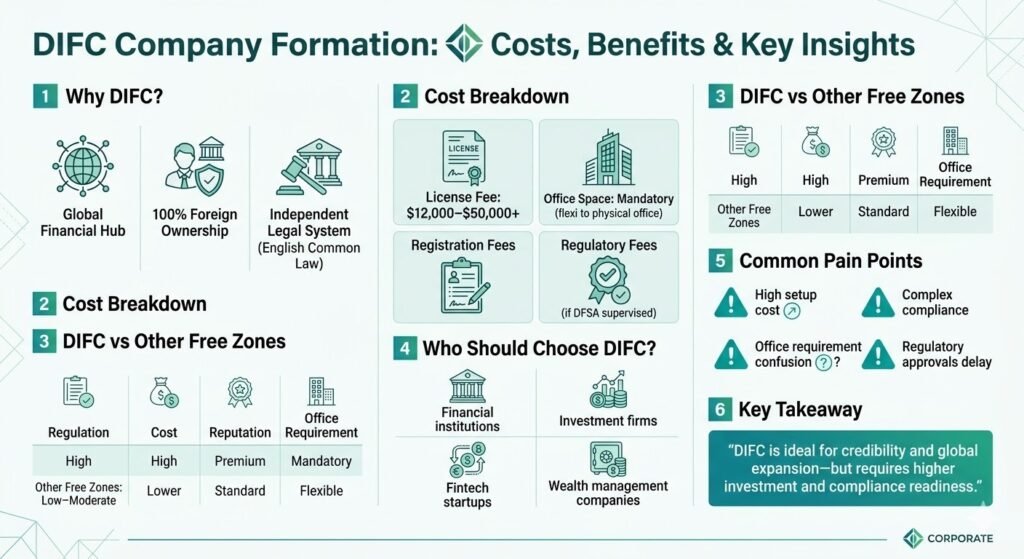
- You have a low budget: If you are looking for the “cheapest UAE visa,” DIFC is not for you. You will spend more on your office lease here than you would on an entire setup in a Northern Emirate.
- You run a simple trading business: If you are moving physical goods through a warehouse, the logistical costs and office requirements of DIFC make no sense. A Mainland or JAFZA license is far superior.
- You want a “Virtual” setup: While some flexi-desk options exist, the DIFC generally demands a physical presence. You cannot run a “ghost” operation here.
DIFC Company Formation Cost
Let’s talk numbers. The “Advertised Cost” on brochures rarely matches the “Bank Account Balance” at the end of Year .
1. Setup Costs
- Registration Fee: Usually around $8,000.
- License Fee: Typically $12,000 per year for non-regulated entities.
- Data Protection Fee: Approx. $500 – $1,250.
2. Office Costs (The Mandatory Expense)
Unlike other zones where you can use a “virtual” office, DIFC requires a physical nexus.
- Flexi-Desk/Co-working: Starting at approx. $5,000 – $8,000 per year (strictly limited).
- Physical Office: In the DIFC “Gate” buildings or nearby towers, expect to pay $50,000+ per year for a modest executive suite.
3. Visa & Compliance
- Visa Cost: Approx. $1,500 – $2,500 per person (including medical and Emirates ID).
- Company Secretary/Audit: Mandatory annual filings will cost you between $3,000 – $7,000 in professional fees.
Advertised vs. Real Cost (Year 1 Estimate)
| Category | Advertised “Starting From” | Real-World Reality |
| Basic Setup | $20,000 | $25,000 (with hidden fees) |
| Holding Company | $15,000 | $20,000+ |
| Financial Firm | $30,000+ | $100,000+ (Capital + Legal) |
Step-by-Step DIFC Company Formation Process
The journey from idea to license usually follows this 8-step path:
- Define Business Activity: Are you providing advice, or are you actually managing money? (The difference between a 2-week and 6-month setup).
- Reserve Company Name: Must be unique and compliant with DIFC naming conventions.
- Initial Application: Submit a high-level business plan to the Registration Authority (RA).
- DFSA Approval (If Regulated): This is the “heavy lifting” phase where your capital and experience are vetted.
- Lease Office Space: You cannot get a license without a lease agreement (Ejari) or a registered address within the DIFC.
- Final Submission: Uploading passport copies, proof of address, and Articles of Association.
- License Issuance: Once the fees are paid and documents approved.
- Open Bank Account: This is the final, and often most difficult, step.
Hidden Costs & Mistakes
Why do some founders regret their DIFC company formation? Usually, it’s because of these three “gotchas”:
- Underestimating the “Substance” Cost: You don’t just pay the license fee; you pay for the prestige of the area. Dining, parking, and administrative services in DIFC are at a premium.
- Ignoring Compliance Overheads: DIFC is a high-transparency zone. You must file audited accounts. If you don’t have an accountant on retainer, these annual fees will surprise you.
- Choosing the Wrong Activity: If you accidentally register for an activity that falls under “Financial Services” when you only meant to “consult,” the DFSA will demand a higher level of capital and compliance that you may not be prepared for.
DIFC vs. Other Free Zones
DIFC vs. ADGM
Both use Common Law. However, ADGM (Abu Dhabi) is often viewed as more “tech-friendly” and slightly more cost-effective for SPVs, while DIFC remains the “old money” heavyweight of Dubai’s banking scene.
DIFC vs. DMCC
DMCC (Jumeirah Lakes Towers) is fantastic for commodities and general trading. It is significantly cheaper than DIFC but operates under UAE Civil Law. If you are an e-commerce brand, choose DMCC. If you are a Hedge Fund, choose DIFC.
Banking Reality: The DIFC Advantage
Is it easy to open a bank account in the UAE? Generally, no. However, a DIFC company formation gives you a massive head start.
Local and international banks (like HSBC, Emirates NBD, and Standard Chartered) view DIFC entities as “low risk” because they know the jurisdiction’s KYC (Know Your Customer) standards are world-class. While a startup in a Northern Emirate might wait 4 months for an account, a DIFC entity can often be onboarded in 4–6 weeks provided your documentation is flawless.
Timeline: How Long Does Setup Take?
- Ideal Timeline: 4–8 weeks.
- Realistic Delays: If you are a regulated entity, expect 6 months.
- Banking Delay: Even with a DIFC license, the bank’s “Compliance Committee” can add another 4 weeks to your timeline.
Tax & Legal Benefits
- Corporate Tax: Following the new UAE regime, a $9\%$ tax applies to taxable profits over AED 375,000. However, most DIFC entities can qualify for “Qualifying Free Zone Person” status to maintain a $0\%$ rate on qualifying income.
- Legal Protection: The ability to litigate in English Common Law courts is the single biggest “insurance policy” for international founders.
Final Decision Framework
- If you are a Fintech Startup raising VC capital $\rightarrow$ Choose DIFC.
- If you are a Regional HQ for a Fortune 500 company $\rightarrow$ Choose DIFC.
- If you are a solo consultant looking for a tax-efficient lifestyle $\rightarrow$ Choose Meydan or IFZA.
- If you are an E-commerce brand selling to the public $\rightarrow$ Choose Mainland Dubai.
Frequently Asked Questions
1. What is DIFC and why do businesses choose to set up there?
DIFC (Dubai International Financial Centre) is a leading global financial hub operating under English Common Law. Businesses choose DIFC for 100% foreign ownership, zero corporate and personal tax, world-class regulation, and access to over 3.5 billion consumers across the Middle East and Africa. It’s ideal for financial services, professional services, and knowledge-based businesses.
2. What types of companies can be formed in DIFC?
You can establish limited liability companies (LLCs), holding companies, special purpose vehicles (SPVs), branches of foreign companies, and regulated entities like investment firms or asset managers. DIFC also supports non-financial activities such as consulting, technology, legal services, and family offices.
3. What are the main requirements for DIFC company formation?
You need at least one shareholder and one director, a registered office in DIFC, a business plan, and proof of financial standing. Regulated activities require Dubai Financial Services Authority (DFSA) approval. Minimum share capital varies by entity type, and certain activities need higher capital and local substance.
4. How long does it take to form a company in DIFC?
Non-regulated entities typically take 2–4 weeks once documentation is complete. Regulated financial services companies requiring DFSA licensing can take 3–6 months depending on complexity. Working with Dubai Business and Tax Advisors speeds up the process and ensures compliance.
5. What are the ongoing costs and compliance obligations for DIFC companies?
Annual costs include license renewal (from AED 10,000–15,000), registered office fees, and audit requirements. Companies must maintain accounting records, file annual financials, and comply with AML regulations. Regulated entities face additional DFSA reporting and capital requirements.
Still Unsure if DIFC is Right for You?
The cost of a mistake in the DIFC can run into the tens of thousands of dollars. At Dubai Business and Tax Advisors, we don’t just “process papers.” We provide a strategic audit of your business goals to see if the DIFC’s high-prestige, high-cost environment actually serves your bottom line.
Whether you need a full DFSA-regulated setup or a simple holding structure, we provide the transparency that most agents avoid.
Ready to build your legacy in Dubai? Contact Dubai Business and Tax Advisors today for a tailored consultation with our specialist advisors.
 hamza seo