

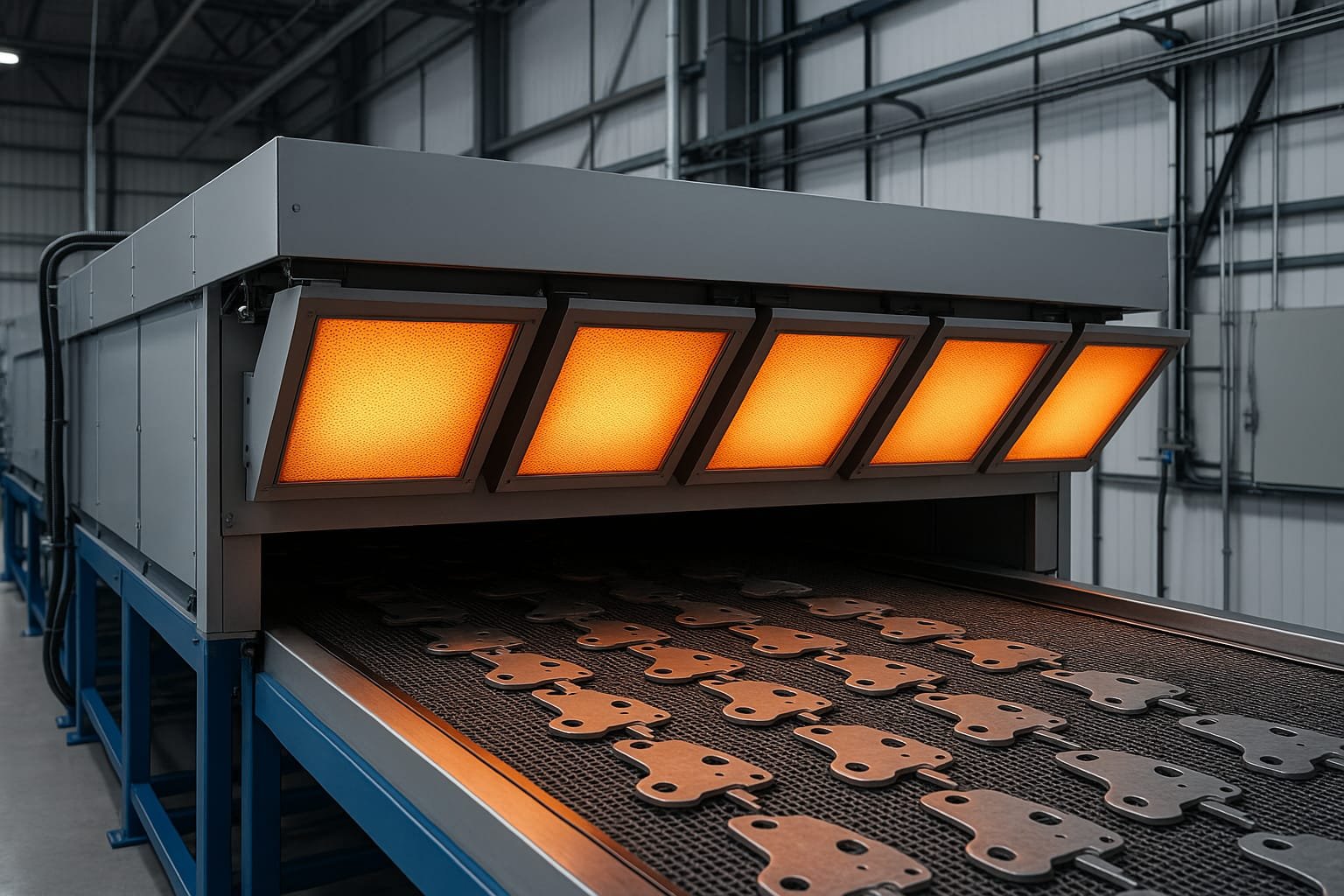
The decarbonisation of industry and the pressure on manufacturers to improve efficiency are pushing companies to revisit a technology that has been around for decades: infrared catalytic heating.In many sectors, from powder coating to food processing and automotive components, catalytic panels are emerging as a decisive lever to stabilise heat treatment quality while reducing energy consumption and operational complexity.
This evolution is particularly relevant for plant managers, production engineers, energy managers and owners of small and medium-sized manufacturing enterprises. Understanding how catalytic panels work, what advantages they bring and how to integrate them into existing lines can make the difference between a plant that struggles with variability and one that produces with repeatability, traceability and competitive costs.
The industrial context: why heat treatment is under pressure
Industrial heat treatment is at the heart of modern manufacturing. It affects the mechanical properties of metals, the curing of paints and coatings, the baking or drying of food, and a wide spectrum of processes where final quality depends on how heat is generated, transferred and controlled over time.
In Europe, according to recent estimates from industrial energy agencies, manufacturing is responsible for roughly a quarter of final energy consumption, and process heating alone accounts for a major share of that figure. A large proportion of heat is still supplied by conventional gas burners or electric resistances, often within ageing ovens with limited insulation and basic control systems.
Over the last decade, three converging trends have increased the pressure on these traditional solutions:
Rising energy prices: volatility in gas and electricity markets has made operating costs more unpredictable, forcing companies to look for systems with higher efficiency and more stable performance.
Stricter environmental targets: European and national climate policies are pushing for lower CO₂ emissions, reduced NOx and VOCs, and better monitoring of environmental performance.
Higher quality and traceability requirements: sectors such as automotive, aerospace, food and medical devices now demand rigorous control of process temperatures, heating curves and product uniformity, making marginal deviations unacceptable.
Traditional combustion-based systems and even some purely electric systems often struggle to simultaneously satisfy these constraints. They can be efficient under ideal conditions, but maintenance, combustion tuning, air-fuel ratio variations and mechanical wear tend to produce uneven heating, hot spots or cold areas in ovens and tunnels. This affects yields, increases scrap rates and complicates certification processes.
It is within this scenario that catalytic infrared technology, and in particular catalytic panels, has regained central stage as a practical option to modernise heat treatment without completely redesigning existing plants.
How catalytic panels work and why they matter
Catalytic panels are devices that generate infrared radiation through a catalytic reaction between a fuel (typically natural gas, LPG or other gaseous fuels) and oxygen, occurring at relatively low temperatures compared to traditional flame burners. The reaction takes place on the surface of a catalyst-coated substrate, which heats up and emits infrared radiation without visible flame.
Unlike conventional burners, catalytic panels operate in a flameless mode, with surface temperatures typically in the range of 300–900 °C depending on design and application. This makes them suitable for a wide variety of processes where controlled, uniform and gentle yet powerful heat input is required.
A key advantage of modern catalytic panels is their ability to convert a high proportion of the chemical energy of the fuel into usable infrared radiation, with efficiencies that can reach and sometimes exceed 70% in well-designed systems, according to data reported by several industrial technology institutes. Because the heat is emitted mainly by radiation rather than convection, energy transfer to the product can be faster and more directed, reducing the need to heat large volumes of air and the metal mass of ovens.
In practical terms, this translates into shorter heating times, more compact equipment, and significant opportunities to retrofit existing lines with modules that can be activated on demand, synchronised with production and integrated with modern control systems.
Key data, statistics and market trends on catalytic infrared technology
Recent industry analyses highlight a steady growth of infrared heating technologies, including catalytic panels, driven by both energy and process performance considerations. While numbers vary by source, some consistent trends emerge across Europe and globally.
According to various market research reports published between 2022 and 2024, the global infrared heating market has been growing at an estimated annual rate of around 5–7%. Within this segment, catalytic infrared systems represent a smaller but rapidly expanding niche, particularly in powder coating, automotive, packaging and food applications.
In Europe, regulatory pressure on emissions from industrial combustion has accelerated the shift towards low-NOx and flameless solutions. National energy agencies and industrial associations report that an increasing share of new or refurbished ovens and dryers in sectors like metal finishing and wood processing now incorporate some form of infrared technology, often combined with conventional convective heating.
From an energy perspective, various case studies published by technical associations show that converting specific phases of the process to catalytic infrared can lead to energy savings in the order of 20–40% for those stages, depending on the baseline technology, the level of control and the thermal insulation of the equipment. In some powder coating lines, reported data indicate cycle time reductions of 30–50% in pre-gel or curing phases when catalytic infrared modules are properly integrated and tuned.
On the emissions side, the flameless nature of catalytic panels allows NOx levels to be drastically reduced compared to conventional flame burners. Several laboratory and field measurements show that NOx emissions from well-designed catalytic systems can be close to or below the detection limits for many standard industrial analyses, while CO levels remain low when systems are correctly dimensioned and maintained.
At the same time, the push for electrification is influencing investment choices. While electric infrared systems remain an option, particularly where electricity is relatively inexpensive or where direct gas use is restricted, many manufacturers continue to value the flexibility and operating cost profiles of gas-fuelled catalytic panels, especially in regions where gas remains competitive or where infrastructure for high-capacity electrical connections is limited.
Practical advantages of catalytic panels in industrial heat treatment
The theoretical benefits of catalytic infrared technology take on real significance only when translated into concrete advantages in plant operations. Several aspects are particularly relevant for SMEs and larger industrial players alike.
1. Temperature uniformity and process repeatability
Catalytic panels emit infrared radiation consistently over their active surface. When properly dimensioned and positioned, this can help create more uniform temperature fields across the product and within the treatment area. This is especially important for:
Powder coating and painting, where uneven heating can lead to defects such as orange peel, incomplete curing or colour variations.
Adhesive curing and laminating, where bond strength and durability depend on precise thermal profiles.
Food processing, where local overheating can compromise product quality or safety.
Because catalytic panels are less sensitive to combustion fluctuations typical of conventional burners, once the system is calibrated, it tends to maintain stable performance over time, provided regular maintenance is performed. This facilitates compliance with quality standards that require documented temperature control and repeatability from batch to batch.
2. Energy efficiency and reduced warm-up times
Infrared energy is absorbed directly by materials that are receptive to the emitted wavelengths, reducing losses associated with heating air or metal structures. In many retrofitted lines, the introduction of catalytic panels in the phases where high surface heat flux is needed allows:
Several documented industrial projects report that ovens originally designed to operate continuously at constant temperature can, with the integration of catalytic modules, adapt more flexibly to variable production volumes without major energy penalties in low-load conditions.
3. Compact design and flexible integration
The modular nature of catalytic panels makes them suitable for both new installations and retrofits. Panels can be arranged to form arrays that cover wide surfaces or localised zones, and they can be mounted above, below or laterally to product flow, depending on the application.
For SMEs, this flexibility is crucial. Instead of replacing an entire oven or dryer, it is often possible to insert catalytic modules in specific points of the line, for example:
As a pre-heating or pre-gel section before the main oven in powder coating lines.
As a booster zone where higher surface temperatures are required for short periods.
As a localised station for special treatments or for products with higher thermal inertia.
This modularity also simplifies phased investments: companies can start with a limited number of panels to address critical bottlenecks and, after validating results, plan more extensive integration.
4. Lower emissions and improved working environment
The absence of visible flame and the lower operating temperatures of catalytic burners compared to conventional combustion reduce NOx formation and limit the production of other combustion by-products. When combined with adequate ventilation and exhaust systems, this can contribute to a cleaner working environment, with reduced exposure to fumes and odours for operators.
In addition, the lower risk of open flame can be a positive factor in terms of safety assessment, especially in contexts where flammable materials or dusts are present. Nonetheless, correct risk analysis and compliance with applicable directives remain essential.
Risks and critical issues if companies fail to modernise heat treatment systems
Maintaining obsolete or inefficient heat treatment systems is not merely a technical choice; it carries strategic and economic implications. Several critical issues can emerge over time if investments in technologies such as catalytic panels are postponed indefinitely.
1. Escalating energy costs and reduced competitiveness
Plants based on outdated burners, poorly insulated ovens or rudimentary control systems tend to waste energy. Even if energy prices were to stabilise, excessive consumption per unit of product directly erodes margins. In markets where competitors adopt more efficient solutions, the cost gap can become difficult to absorb without sacrificing profitability or quality.
Over a multi-year horizon, the cumulative cost of wasted energy often exceeds the initial investment required to modernise systems, especially when considering that many retrofit projects involving catalytic panels can be implemented gradually and without prolonged production downtime.
2. Increased scrap rates and quality non-conformities
Inconsistent heat treatment leads to defects that may remain undetected until late in the process, or even after delivery to the customer. This is particularly problematic in sectors such as automotive components, aerospace, coatings and medical devices, where mechanical performance, corrosion resistance or adhesion are critical.
Quality incidents not only generate direct costs (rework, scrap, returns) but also undermine customer trust and complicate certification audits. Failure to control and document the thermal process makes it harder to demonstrate compliance with internal specifications and external standards.
3. Environmental and regulatory non-compliance
Emission limits for NOx, CO, VOCs and particulate matter are becoming increasingly stringent in many jurisdictions. Plants with traditional combustion systems that are not adapted or tuned may face difficulties meeting these limits, particularly in densely populated or industrially sensitive areas.
Non-compliance can lead to penalties, restrictions on operating hours or the obligation to install expensive end-of-pipe abatement systems. In many cases, investing directly in cleaner and more efficient heat generation technologies, such as catalytic panels, proves more cost-effective over the medium term than attempting to correct emissions solely at the stack.
4. Loss of opportunities in innovation and product development
Companies that restrict themselves to existing heat treatment capabilities may struggle to introduce new products or coatings that require more precise or flexible thermal profiles. Technologies like catalytic infrared panels enable more sophisticated heating curves, rapid temperature ramps and differentiated treatment zones, creating room for innovation in materials and processes.
Without these capabilities, design offices and R&D teams are constrained by the limitations of existing equipment, making it harder to respond to market demands for improved performance, lighter components, more resistant coatings or more sustainable materials.
Opportunities and competitive advantages with catalytic panels
For companies that choose to adopt catalytic panels strategically, opportunities go beyond simple energy savings. The most interesting benefits emerge when technology is integrated into a broader review of processes and business models.
1. Higher productivity and better line balancing
By reducing heating times and improving temperature uniformity, catalytic panels can increase throughput without necessarily extending physical plant footprint. In some sectors, companies have managed to process more batches per shift or to reduce the number of ovens in series, freeing up space for other operations or new product lines.
In mixed-production plants, greater controllability of heat treatment can also improve line balancing. Processes that used to constitute bottlenecks due to long or unstable thermal cycles can be streamlined, aligning them with faster upstream and downstream phases.
2. Simplified maintenance and operational reliability
Modern catalytic panels are designed for ease of maintenance, with modular components and diagnostic systems that detect malfunctions or deviations. Compared to complex burner systems with moving parts and sensitive mechanical adjustments, catalytic modules can offer:
Fewer mechanical components subject to wear.
Simplified periodic inspections and cleaning.
More predictable performance degradation, making it easier to schedule proactive maintenance.
This translates into fewer unplanned stops and more stable production planning, critical aspects especially for SMEs that cannot afford extended downtime.
3. Integration with digitalisation and Industry 4.0
Catalytic panels lend themselves well to integration with modern control and monitoring systems. Through appropriate sensors, actuators and PLC interfaces, it is possible to:
Monitor temperatures, power levels and operating times in real time.
Adjust infrared power according to product type, line speed or recipes stored in the control system.
Record process data to support traceability, quality audits and continuous improvement initiatives.
In an Industry 4.0 perspective, this data can feed into higher-level systems, enabling predictive maintenance algorithms, energy dashboards and advanced optimisation of production schedules based on real capacity of thermal processes.
4. Support for decarbonisation and corporate sustainability strategies
Although the fuel used by many catalytic systems is still gas, the increase in efficiency and the reduction in emissions per unit of product contribute directly to the decarbonisation path of companies. In some contexts, catalytic technologies can be combined with biogas, biomethane or other low-carbon fuels, further improving environmental performance.
For companies that publish sustainability reports or are required to demonstrate progress on Scope 1 and Scope 2 emissions, documenting improvements in process heating efficiency and the adoption of cleaner technologies can be an important part of their climate strategy.
Regulatory and normative aspects: what companies need to know
The adoption of catalytic panels, like any industrial energy technology, must be framed within applicable regulatory and normative requirements. While specific rules vary by country and sector, some common dimensions can be identified.
1. Safety and conformity of equipmen
Catalytic panels used in industrial environments must comply with safety directives and standards relating to gas appliances, pressure equipment, electrical safety and, where applicable, equipment intended for use in potentially explosive atmospheres.
Companies must verify that the equipment supplied is accompanied by the necessary conformity declarations, technical documentation and instructions for safe installation, operation and maintenance. Integration into existing systems may require further risk assessments and, in some cases, adaptation of fire protection or gas detection systems.
2. Emission limits and environmental permits
Even though catalytic panels typically produce lower emissions than traditional burners, plants that use them remain subject to national and local rules governing atmospheric emissions. This may involve obtaining or updating environmental permits, measuring pollutants at the stack and maintaining registers of operating parameters.
In some jurisdictions, the adoption of cleaner technologies can facilitate compliance with existing limits or qualify companies for incentive schemes aimed at reducing emissions and improving energy efficiency. It is therefore advisable to consider regulatory aspects at the design stage of any retrofit project.
3. Energy efficiency obligations and reporting
In many European countries, larger companies are subject to periodic energy audits or must implement energy management systems in accordance with recognised standards. Even SMEs increasingly participate in voluntary schemes or consortia promoting energy efficiency.
Investments in catalytic panels and the resulting savings can be included in these audits as improvement measures, often with positive effects in terms of access to financial incentives, better financing conditions or improved positioning in supply chains that assess suppliers on the basis of environmental and energy performance.
How to approach the transition to catalytic panels: practical guidelines
The choice to introduce catalytic panels in an industrial plant should be based on a structured analysis, avoiding both simplistic enthusiasm and excessive conservatism. Some practical steps can help businesses manage this transition effectively.
1. Map existing heat treatment processes
The first step is to identify all ovens, tunnels, dryers and heat treatment stations, documenting for each:
Type of process (curing, drying, baking, annealing, etc.).
Temperature ranges and required time profiles.
Energy sources currently used and their consumption.
Known issues (non-uniformity, defects, maintenance, bottlenecks).
This mapping allows the identification of processes where infrared catalytic technology can provide the greatest benefit, such as phases requiring high surface heat fluxes or where variability in temperature has the most significant quality impacts.
2. Conduct feasibility and cost-benefit analysis
Once critical areas are identified, a more detailed technical and economic analysis is needed. This should include thermal simulations or pilot tests where appropriate, comparison of alternative solutions, estimation of investment costs and operating savings, as well as evaluation of payback times.
It is important to consider not only direct energy savings but also indirect benefits such as reduced scrap, improved productivity, possible extension of equipment life and decreased maintenance costs.
3. Plan modular and phased implementation
Particularly for SMEs with limited financial and organisational resources, a phased approach can be effective. Instead of attempting a complete overhaul of heat treatment systems in a single step, companies can prioritise a pilot line or a particularly critical process phase.
After validating the results and building internal experience in managing catalytic panels, subsequent phases can be planned with greater confidence, adjusting design choices in light of lessons learned.
4. Invest in training and internal competencies
Technology adoption is effective only when operators and technicians understand how to manage it. Training should cover not only the basic operation of catalytic panels but also:
Recognition of normal versus anomalous operating conditions.
Routine maintenance activities and correct cleaning procedures.
Understanding the relationship between process parameters and product quality.
Developing in-house competencies helps companies use the full potential of technology and dialogue more effectively with technology providers and consultants.
FAQ on catalytic panels in industrial applications
Are catalytic panels suitable only for new plants, or can they be retrofitted to existing lines?
Catalytic panels are particularly well suited to retrofits. Their modular design allows integration into existing ovens and tunnels, either as pre-heating, booster or finishing zones. A preliminary technical assessment is necessary to verify space, gas supply and control system compatibility, but many retrofits can be carried out with limited modifications to existing infrastructure.
What fuels can be used with catalytic panels, and how does this affect performance?
Most industrial catalytic panels are designed to operate with natural gas or LPG, sometimes with the possibility of using other compatible gaseous fuels. Fuel choice affects energy cost, emissions and, in some cases, achievable surface temperature. Proper calibration and, where necessary, specific catalysts ensure stable performance and compliance with emission limits for the chosen fuel.
How long do catalytic panels last, and what maintenance do they require?
The service life of catalytic panels depends on design, operating conditions and maintenance quality, but under appropriate conditions they can operate for several thousand hours before requiring significant refurbishment or replacement. Routine maintenance typically involves periodic cleaning of surfaces, inspection of gas supply components and verification of correct operating temperatures. Clear maintenance schedules and adequate training help maintain efficiency and reliability over time.
Conclusion: choosing catalytic panels as a strategic investment
Infrared catalytic technology is no longer a niche solution reserved for experimental plants. Catalytic panels have become a mature, robust and flexible option for modernising industrial heat treatment, combining energy efficiency, process stability and environmental performance.
For companies that view heat treatment as a strategic phase rather than a simple auxiliary service, the question is less whether to consider this technology and more how and when to integrate it into their plants. A structured approach to analysis, gradual implementation and investment in skills can turn catalytic panels into a key asset in the pursuit of competitiveness, quality and sustainability.
For production managers, plant engineers and business owners who recognise critical issues in their current heat treatment systems – from unstable temperatures to high energy bills and emission constraints – this is the right moment to evaluate, with technical rigour and a medium-term perspective, how catalytic panels can reshape their processes and simplify the path to consistent, reliable results.
 hamza seo