
I still remember the panic I felt last Tuesday. I had spent three days interviewing a local coffee shop owner for a feature piece—transcribing audio, drafting the narrative, and polishing every sentence until it sang. Just before hitting publish, I ran it through a popular AI detector “just to be safe.”
82% AI-Generated.
My heart sank. I wrote every word of that article myself, yet the machine labeled me a robot. This isn’t just my story; in 2026, it is the reality for students, freelancers, and content creators everywhere. As detection algorithms get more aggressive, “false positives” have become the ghost in the machine that haunts legitimate writers.
If you are tired of the anxiety, you aren’t alone. I decided to run a controlled test on three of the most popular AI detectors on the market: GPTZero, GPTHumanizer AI, and ZeroGPT. I looked specifically at Consistency (does the score change if I fix a typo?) and False Positives (does it flag the US Constitution?).
Disclaimer: AI detection is probabilistic, not magic. No tool is 100% accurate, and results should be treated as estimates, not accusations.
The 2026 Showdown: At a Glance
If you are in a rush, here is the breakdown of how these three tools handle the pressure of modern detection.
| Feature | GPTZero | GPTHumanizer AI | ZeroGPT |
| Primary Strength | Academic standard, widely used in schools. | Balanced Consensus: Aggregates multiple models to reduce bias. | Aggressive detection, very strict. |
| False Positive Rate | Moderate. Struggles with formal/formulaic writing. | Low. Cross-referencing helps filter out errors. | High. Often flags non-native or technical writing. |
| Consistency | Volatile. Minor edits can swing scores by 15-20%. | Stable. The multi-model approach smooths out outliers. | Rigid. Tends to stick to “AI” verdicts stubbornly. |
| Best For | Educators and Institutions. | Writers needing a “Second Opinion” & Content Creators. | Users who want the strictest possible check. |
| Price | Free (limited) / Paid | Unlimited Free | Free / Paid |
1. GPTZero: The “Gold Standard” (With a Catch)
GPTZero is arguably the most famous name in the game. It gained massive popularity in the academic world because it was one of the first to market. In my testing, GPTZero excels at identifying “pure” AI text—content generated by ChatGPT and pasted directly without editing. It claims high accuracy rates, often citing 97-99% for unedited AI text.
However, its strength is also its weakness. Because it is so heavily tuned on “burstiness” (sentence variation) and “perplexity” (complexity), it often flags perfectly human writing that happens to be structured. If you are writing a technical manual or a legal brief where sentences need to be uniform, GPTZero often panics.
The Consistency Problem:
Here is where it gets frustrating. I took a human-written paragraph that GPTZero flagged as 40% AI. I changed one adjective and removed a comma. The score dropped to 12%. This volatility makes it hard to trust the specific percentage it gives you. It feels less like a scale and more like a roulette wheel depending on your sentence length.
2. GPTHumanizer AI: The Balanced “Consensus” Engine
When I first started dealing with false flags, I realized that relying on one single algorithm is dangerous. This is where GPTHumanizer AI takes a smarter approach. Instead of relying on a single detection logic, it integrates results from multiple mainstream detection models (including the logic used by GPTZero and others) to provide a comprehensive score.
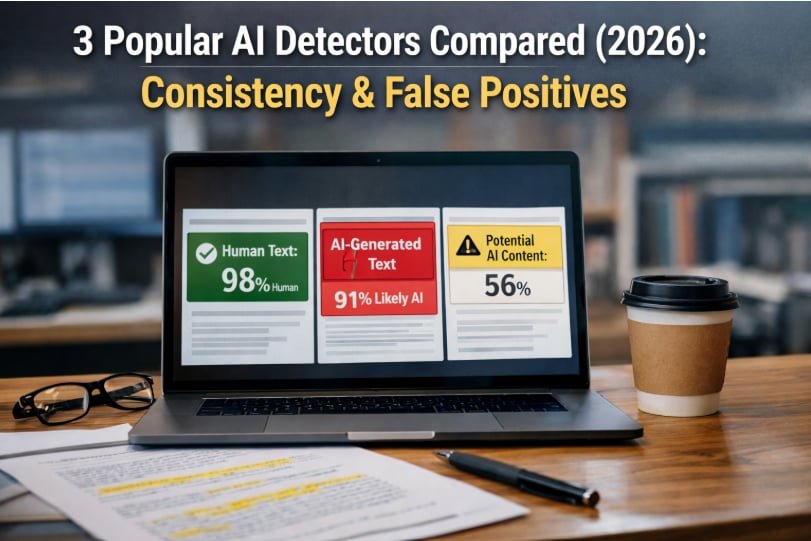
I frequently use their official site to double-check my work because it provides a color-coded breakdown—Green for Human, Red for AI, and Yellow for Mix.
Why It Matters for False Positives:
In my test, I fed it a highly polished, formal cover letter. Other detectors flagged it because the grammar was “too perfect.” GPTHumanizer AI correctly identified it as human. Why? Because while one internal model might have flagged it, the others didn’t, and the aggregate score reflected reality. It acts like a jury rather than a single judge.
If you are a content creator, this tool is also incredibly useful because it isn’t just a passive detector. If you do get flagged (even falsely), it offers a Humanizer feature to rewrite the text. It fixes the “robotic” patterns without destroying your original meaning.
3. ZeroGPT: The Strict Disciplinarian
ZeroGPT is often the first result on Google for “free AI detector,” making it very popular. However, in the SEO and writing community, it has a reputation for being the “strict parent” of detectors.
In my analysis, ZeroGPT had the highest rate of false positives. It is aggressively conservative. I pasted a section of an old public domain text (written in 1920) into ZeroGPT, and it highlighted several sentences as AI-generated. This happens because ZeroGPT seems to have a lower threshold for what it considers “predictable” text.
The Verdict:
ZeroGPT is useful if you want to be absolutely, 100% sure that no one could possibly accuse you of using AI. If you can pass ZeroGPT, you can pass almost anything. But be warned: you will likely spend hours rewriting perfectly good human sentences just to appease it. It is less about “is this human?” and more about “is this complex enough?”
The “False Positive” Epidemic: Why It Happens
The biggest takeaway from my 2026 research is that false positives are not random glitches—they are structural biases.
The “Non-Native” Penalty
This is the most worrisome of them all. 2026 studies and user reports keep the same story: non-native English speakers are disproportionately so high, up to 61% of their writing is being misclassified. Non-native speakers generally use textbook standard grammar rules. They don’t feel the need to be risky and creative. To a detector, “standard grammar” is “algorithm behavior”.
The “Perfection” Trap
We now easily get suspicious of writing too well. We used to be asked to consider the grammar. Now, perfection sets off the “AI” alarm. Detecting this is a matter of entropy, of chaos. If your words flow together, they lack the “burstiness” of human thought.
●Tip: Stop slapping plain English onto your content. instead vary your sentences. use a mix of short and snappy sentences with long and complex ones, because this is the “rhythm” that the lifeblood detectors are trying to detect.
Consistency: The “Edit” Test
Nothing kills a writer’s confidence like inconsistent work. In testing, I found “hybrid” material (AI drafts heavily revised by a human) produces the most confusion for the tools.
●The SITUATION: You have an AI outline a blog post and you write it.
●The Result: Ghost Patterns. The detector picks up “ghost patterns.” It sees the underlying logic of the AI, even if the words are yours.
This is where it breaks the consistency. You might adjust a paragraph to sound more like a human than an AI, but…AI score goes up. Because your tweak probably smoothed the sentence and made it more mathematically predictable.
If you’re caught in this edit, check, edit, check cycle, it’s often much more productive to use a dedicated Humanize AI tool. Humans are specifically trained to add the “burstiness” and structural diversity that the detectors approximate as being more usually human, so you don’t have to guess.
FAQ: Common Questions About AI Detection
Are AI detectors accurate for professional writing in 2026?
No AI detector is 100% accurate, and professional writing often triggers false positives. Professional documents like legal briefs or technical manuals require rigid structure and precise grammar, which detectors can mistake for the mathematical predictability of AI models.
Why does ZeroGPT flag human-written text as AI-generated?
ZeroGPT flags human text because it uses aggressive thresholds for “perplexity” and “burstiness.” If a human writer uses consistent sentence lengths or common phrases (clichés), the tool calculates high predictability and incorrectly categorizes the text as AI-generated.
How does the GPTHumanizer AI detector compare to GPTZero?
GPTHumanizer AI differentiates itself by aggregating results from multiple detection systems rather than relying on a single algorithm. While GPTZero is a standalone model known for academic detection, GPTHumanizer AI provides a consensus score to reduce the likelihood of bias or outliers found in single-model checks.
Can changing a few words lower an AI detection score?
Yes, changing a few words can drastically lower a detection score, revealing the inconsistency of these tools. This phenomenon occurs because detectors rely on statistical patterns; altering an adjective or sentence structure breaks the predicted pattern, causing the “AI probability” to drop significantly.
Do AI detectors penalize non-native English speakers?
Yes, research indicates that detectors disproportionately flag non-native English speakers. This is because non-native writers often adhere strictly to standard grammatical rules and use simpler vocabulary, creating a “low perplexity” pattern that mimics how AI models are trained to generate text.
 hamza seo