

When entrepreneurs look toward the United Arab Emirates, they often see a landscape of glitzy skyscrapers and high-octane Free Zones. But beneath the surface of the “Mainland” and “Free Zone” options lies a quieter, more streamlined vehicle that has become the secret weapon for international asset protection and global trade: the RAK ICC company setup.
However, a common point of confusion remains: Is RAK ICC really the “cheapest” option, or is it simply the most efficient? In the world of international tax and corporate structuring, “cheap” can often be expensive if the structure doesn’t serve its purpose. This guide isn’t just about why RAK ICC is cost-effective; it’s about whether it is the right strategic choice for your specific business model.
What Is RAK ICC & How Offshore Companies Work
What is RAK ICC?
The Ras Al Khaimah International Corporate Centre (RAK ICC) is a world-class corporate registry located in the Emirate of Ras Al Khaimah. It is a dedicated authority for the incorporation of International Business Companies (IBCs). Unlike a Free Zone entity, which is designed for people wanting to live and work inside the UAE, RAK ICC is an “offshore” jurisdiction.
What Is an Offshore Company in the UAE?
In the UAE context, an offshore company is a non-resident entity. It is legally registered in the UAE, but it is strictly prohibited from conducting business with UAE residents or trading within the local market. Think of it as a secure, internationally recognized “legal box” that sits in the UAE but looks outward to the rest of the world.
Types of Businesses Using RAK ICC
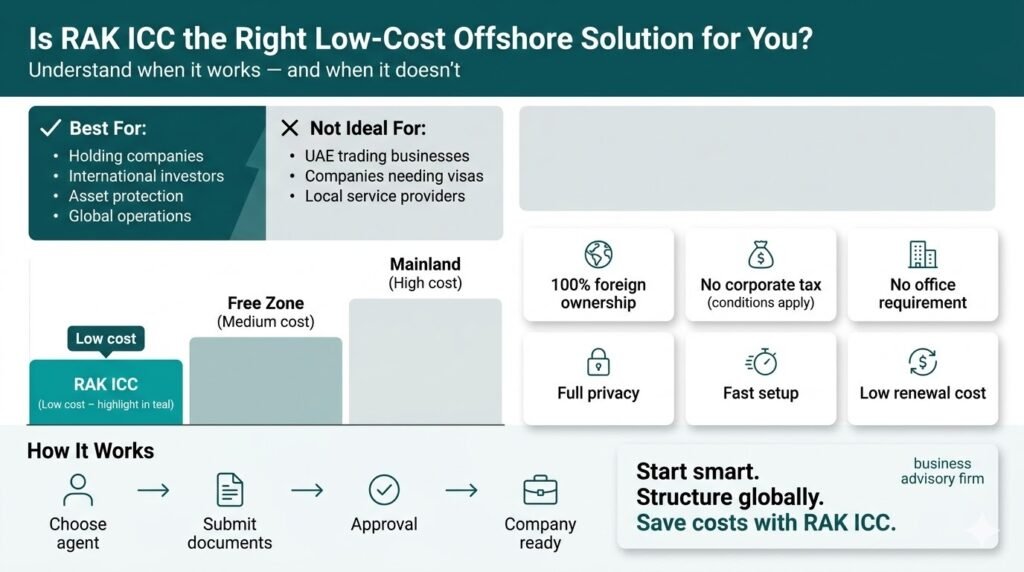
- Holding Companies: To hold shares in subsidiaries globally.
- Asset Protection: To own real estate (specifically in Dubai via the DLD MOU) or intellectual property.
- International Trade: Buying goods in one country and selling them in another without the goods ever touching UAE soil.
Why RAK ICC Is Considered the Most Cost-Effective Offshore Setup
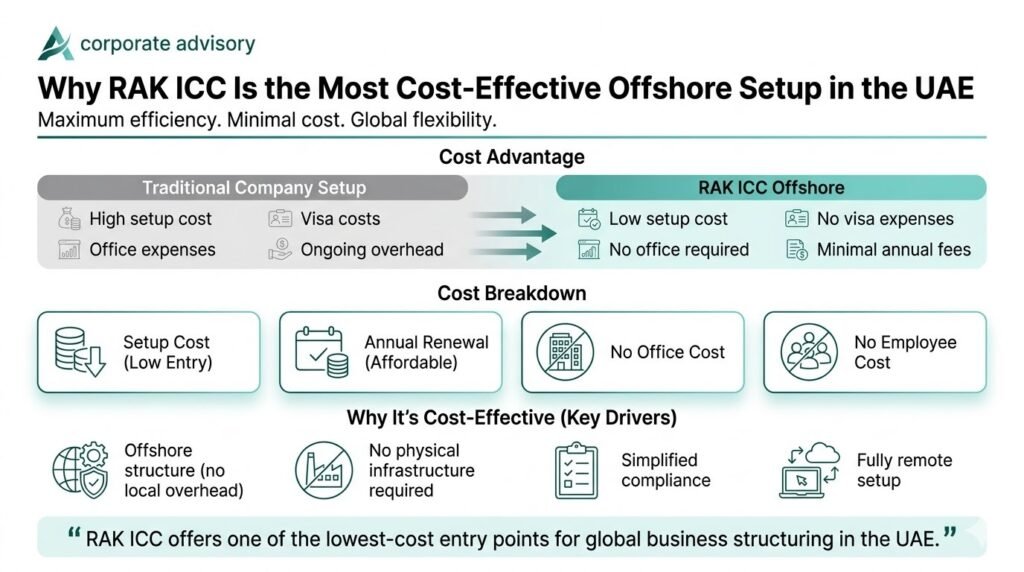
The term “cost-effective” is frequently used, but in the case of a RAK ICC company setup, it is backed by mechanical financial advantages.
No Office Requirement
This is the single largest cost saver. In a Mainland or Free Zone setup, you are legally required to lease physical office space or a “flexi-desk.” In RAK ICC, your “registered office” is simply the office of your Registered Agent. You save thousands of dollars annually in rent, utilities, and maintenance.
Low Setup & Renewal Fees
When you compare the government registration fees of RAK ICC to those of JAFZA (Jebel Ali) or ADGM (Abu Dhabi), RAK ICC consistently comes out as the more budget-friendly option. Furthermore, the annual renewal fees are predictable and significantly lower than operational licenses.
Minimal Compliance Requirements
While RAK ICC maintains high standards, the compliance burden for a non-regulated offshore entity is lower than for a mainland firm. You generally do not need to file annual audits with the authority (though you must keep records), which reduces your annual accounting and legal spend.
Cost vs. Value: The Strategic Angle
Cheap is only good if it works. RAK ICC provides a “premium” offshore reputation. Unlike some “tax haven” islands that are now blacklisted by major economies, the UAE (and RAK ICC specifically) maintains a white-listed, compliant status with the OECD. This “value” ensures your company stays relevant in the global banking system.
Is RAK ICC Right for You?
This is the crossroads where many entrepreneurs make the wrong turn. A RAK ICC company setup is a surgical tool; it must be used for the right procedure.
Choose RAK ICC If:
- You need a parent company to hold global assets.
- You are an international consultant working with clients outside the UAE.
- You want to buy freehold property in Dubai under a corporate name.
- You want 100% foreign ownership with zero local interference.
Avoid RAK ICC If:
- You need a UAE residency visa: Offshore companies cannot sponsor visas for owners or employees.
- You want to trade with UAE companies: You cannot invoice a company in Dubai or Abu Dhabi for local services.
- You need a physical shop or office: You are not allowed to have a physical presence.
Quick Decision Checklist
- Do I need to live in the UAE? (If Yes $\rightarrow$ Free Zone/Mainland)
- Are my customers located inside the UAE? (If Yes $\rightarrow$ Mainland)
- Is my primary goal asset holding or international trade? (If Yes $\rightarrow$ RAK ICC)
Real Cost Breakdown of RAK ICC Company Setup
Transparency is the hallmark of a credible advisor. Here is what you should actually expect to pay.
Initial Setup Cost
The first-year costs generally range between $2,500 and $3,500. This includes:
- Government registration fees.
- Registered Agent fees (mandatory by law).
- Memorandum and Articles of Association (MOA/AOA) drafting.
Annual Renewal Costs
Ongoing maintenance is where RAK ICC shines. Expect to pay between $1,500 and $2,000 annually to keep the company in “Good Standing.”
Optional Costs
- Nominee Services: If you require a high level of privacy for shareholders/directors.
- Bank Account Assistance: This is often a separate professional fee because of the complexity involved.
Hidden Costs Entrepreneurs Miss
- Document Attestation: If you need to use your RAK ICC documents in your home country, you will need Ministry of Foreign Affairs (MOFA) attestation, which can cost several hundred dollars per document.
- Economic Substance Regulations (ESR): If your company earns “Relevant Income,” you must file annual notifications.
Banking Reality. Can You Open a Bank Account with RAK ICC?
Let’s address the elephant in the room. Banking is the biggest hurdle for any offshore entity globally, and a RAK ICC company setup is no exception.
Why Banking Is the Challenge
Banks in the UAE and abroad are under strict Anti-Money Laundering (AML) pressure. Because an offshore company has no physical office and no “local” footprint, banks view it as a higher risk.
What Banks Require
To even be considered, you must demonstrate:
- Business Substance: A clear reason why the company exists.
- Source of Wealth: Proof of where the investment capital originated.
- Counterparty Info: Who are your suppliers and customers?
Common Reasons for Rejection
- The shareholder has no experience in the industry.
- The business plan is vague or looks like a “shell” for money laundering.
- The bank cannot verify the source of funds.
Tips to Improve Approval Chances
- Maintain a healthy balance: Many UAE banks require a minimum balance of AED 100,000 to 500,000 for offshore entities.
- Professional Business Plan: A two-page Word document won’t cut it. You need a detailed, professional dossier.
- Consider Neobanks: Platforms like Wio or international neobanks are often more receptive to offshore structures than traditional “brick and mortar” banks.
RAK ICC vs. Other UAE Company Setup Options
| Feature | RAK ICC (Offshore) | JAFZA Offshore | UAE Free Zone |
| Setup Cost | Low | High | Medium/High |
| Renewal Cost | Low | High | Medium |
| UAE Residency Visas | None | None | Included |
| Physical Office | Prohibited | Prohibited | Mandatory |
| Dubai Property Holding | Yes (MOU) | Yes | Yes |
| Setup Timeline | 3–5 Days | 2–3 Weeks | 1–2 Weeks |
Which One Should You Choose?
If your primary goal is owning a villa in the Palm Jumeirah or holding a global investment portfolio without the need for a visa, RAK ICC is the clear winner on cost. If you want to live in Dubai and run a marketing agency, a Free Zone (like IFZA or DMCC) is your only option.
What You Can and Cannot Do with RAK ICC.
What You Can Do
- Hold Assets: Shares in other companies, intellectual property, or real estate.
- International Trade: Invoicing clients in Europe or Asia for goods shipped between non-UAE ports.
- Open Bank Accounts: Both in the UAE (with substance) and internationally.
What You Cannot Do
- Trade in UAE: You cannot sell goods to a customer in the Mall of the Emirates.
- Get a UAE Visa: You will remain a tourist or a resident of another country.
- Hire Local Staff: You cannot issue UAE labor contracts.
Common Mistakes Entrepreneurs Make with Offshore Setup
- Choosing Based on Price Only: If the agent doesn’t understand your banking needs, you’ll end up with a “dead” company, a legal entity with no way to move money.
- Ignoring Banking Requirements: Thinking you can open an account with $0 and a passport. The world has changed; banking requires preparation.
- Selecting the Wrong Structure: Using a standard IBC when you actually need a Segregated Portfolio Company (SPC) for an investment fund.
- Expecting UAE Operations: Attempting to use an offshore license to sign a lease for a physical warehouse.
- Not Planning Long-Term: Failing to account for Economic Substance Regulations (ESR) which can lead to hefty fines if ignored.
Legal, Tax & Compliance Considerations
Is RAK ICC Legal?
Absolutely. It is a government-backed registry that complies with all UAE federal laws and international standards.
Tax Implications
While the UAE has a 0% or 9% corporate tax, offshore companies that do not trade in the UAE generally fall under the 0% bracket. However, you must consider the “Controlled Foreign Corporation” (CFC) rules of your home country (e.g., the UK or Germany).
Reporting & Compliance
Every RAK ICC company must maintain a Register of Directors and Shareholders. While these are not public, they must be kept up-to-date with your Registered Agent.
Real Use Cases. Who Actually Benefits from RAK ICC?
- Holding Company Owners: A tech founder in London who wants to hold their global patents in a tax-neutral, stable environment.
- International Consultants: A digital nomad who works with US clients while traveling.
- Property Investors: An overseas investor who wants to buy five apartments in Dubai and hold them under one corporate umbrella for easy inheritance planning.
- E-commerce (Non-UAE): Drop-shippers who source from China and sell to the US, using the UAE as a neutral banking and management hub.
Why Smart Entrepreneurs Still Choose RAK ICC?
At its core, a RAK ICC company setup offers three things: Simplicity, Privacy, and Scalability.
It is for the entrepreneur who doesn’t need the “noise” of a physical office. It is for the investor who values the UAE’s stability but operates on a global stage. When structured correctly by a professional advisor, it is the most robust and cost-effective legal vehicle in the Middle East.
How Dubai Business and Tax Advisors Can Help
Navigating the offshore world is about more than just filling out a form. It is about strategic structuring. At Dubai Business and Tax Advisors, we don’t just “sell” licenses; we build corporate legacies.
Strategic Business Structuring
We analyze your tax residency, your banking needs, and your long-term exit strategy before recommending a jurisdiction.
End-to-End RAK ICC Company Setup
From name reservation to the delivery of your corporate folder, we handle every detail with the RAK ICC authority.
Banking & Compliance Support
We don’t leave you at the bank’s doorstep. We help prepare your dossier to ensure you have the highest possible chance of approval.
FAQS(Frequently Asked Questions)
How do RAK ICC formation costs compare to other UAE offshore and free zone options?
RAK ICC is significantly more affordable than most UAE alternatives. Formation costs are considerably lower than ADGM or DIFC structures, which can run into tens of thousands of dirhams. Even compared to other offshore options like Ajman or Jebel Ali Free Zone, RAK ICC offers a more competitive fee structure with fewer mandatory add-ons, making it the go-to choice for cost-conscious foreign investors.
Are there any hidden costs investors should be aware of when setting up a RAK ICC company?
RAK ICC is relatively transparent on pricing. The main costs are the registration fee, annual renewal fee, and registered agent fee all of which are known upfront. Unlike some jurisdictions, there are no requirements for a physical office, local employee, or minimum share capital, which eliminates several common hidden costs that inflate setup expenses elsewhere.
Does RAK ICC require a minimum share capital, and how does this benefit investors?
No minimum share capital is required for a standard RAK ICC Business Company. This means investors can incorporate with as little as one US dollar of share capital, freeing up working capital for actual business operations rather than tying it up in a statutory requirement, a significant advantage over many competing jurisdictions.
How does RAK ICC’s tax environment contribute to its cost-effectiveness?
RAK ICC companies benefit from zero corporate tax on offshore income, zero personal income tax, and zero withholding tax on dividends and profits. While the UAE introduced a 9% corporate tax in 2023, qualifying offshore companies with no UAE-sourced income remain outside its scope, preserving the tax efficiency that makes RAK ICC so attractive to international investors.
What ongoing annual costs should a RAK ICC company budget for?
Annual costs are minimal and predictable. Investors typically budget for the annual government renewal fee, registered agent retainer, and basic accounting record maintenance. There are no mandatory audit requirements for most structures, no public filing fees, and no local staffing obligations keeping the total annual cost of maintenance well below comparable structures in other jurisdictions.
Is RAK ICC still cost-effective for investors who also need a UAE bank account?
Yes, though bank account opening adds to the overall cost. Fees vary by bank and the level of due diligence required. However, even factoring in banking setup costs, the total outlay for a RAK ICC structure with a UAE bank account remains significantly lower than establishing an equivalent onshore or ADGM structure making it excellent value for international investors seeking Middle East banking access.
Conclusion
Make Your Move with Confidence
A RAK ICC company is the ultimate tool for the cost-conscious yet strategically minded entrepreneur. It delivers the prestige of a UAE-registered structure without the overhead of a physical office, local staff, or excessive compliance burdens all at a fraction of the cost of comparable jurisdictions.
However, the key to long-term success lies in the preparation. Getting your banking strategy right, understanding your international tax obligations, and structuring your company correctly from day one are what separate a thriving offshore structure from a dormant one. Don’t choose based on price alone choose based on where your business is headed and what structure will take it there.
Get in touch with Dubai Business and Tax Advisors today and let us build the right foundation for your business, one that is cost-effective today and built to scale tomorrow.
 hamza seo