

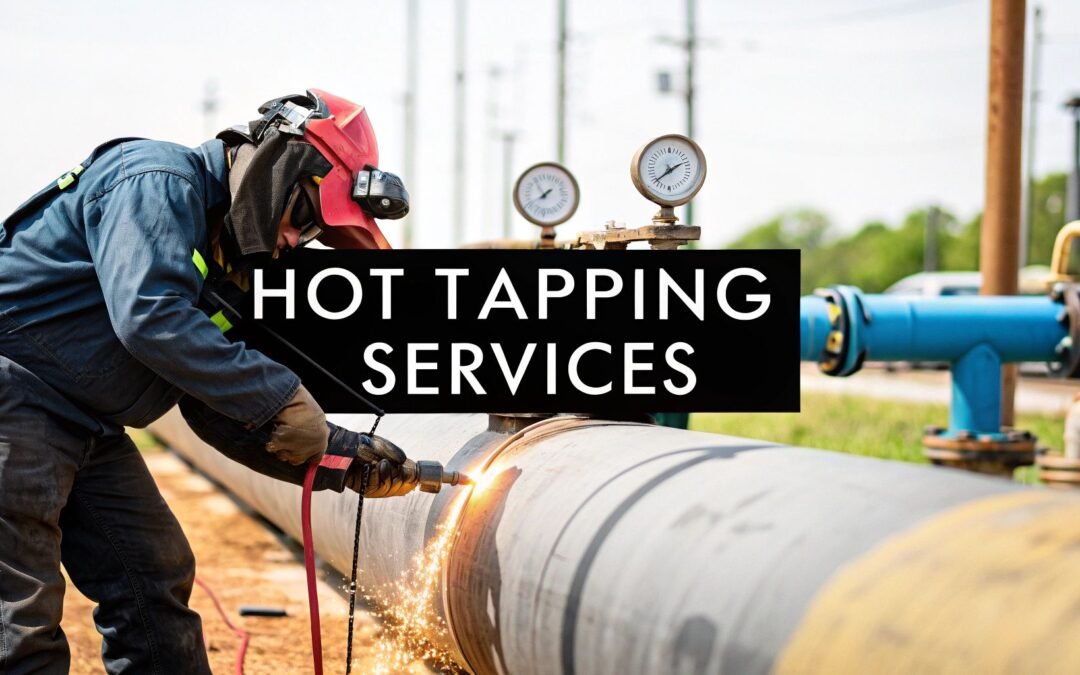
Hot tapping has become one of the most valuable techniques in modern pipeline and utility maintenance. It allows technicians to create a connection to an active pipeline without shutting down service — saving time, money, and operational disruption. Today, a major innovation is that Minitap allows hot tapping in confined spaces, opening new possibilities for projects that were previously considered too tight, risky, or impractical.
Across Australia, where urban density and aging infrastructure often combine, confined-space access is one of the biggest barriers to safe and efficient pipeline work. With compact hot tapping solutions now available, contractors and utilities can perform critical modifications with greater precision and safety than ever before.
Understanding Hot Tapping and Why It Matters
Hot tapping is a controlled method of cutting into a live pipe system — such as water, gas, or industrial process lines — while it remains in service. Instead of shutting down a network, draining lines, or disrupting customers, crews can install new branches or valves while operations continue.
This approach is especially important for:
- Municipal water systems
- Industrial processing plants
- Gas distribution networks
- Fire protection systems
- Remote utility lines
The challenge arises when the connection point is located in a vault, pit, plant room, or underground chamber. That’s where confined-space hot tapping becomes complex and where specialized compact tools make a measurable difference.
Common Confined Space Challenges in Australian Infrastructure
Australian infrastructure projects frequently involve restricted access environments. From inner-city service corridors to mining and processing facilities, space constraints are common.
Typical confined-space challenges include:
Limited Equipment Clearance
Traditional hot tapping machines are often large and require wide setup space and stable mounting room. In pits or narrow chambers, this clearance simply doesn’t exist.
Worker Safety Risks
Confined spaces introduce ventilation concerns, restricted escape paths, and higher hazard exposure. Bulky machinery increases both setup time and risk.
Complex Pipe Positions
Pipes in confined areas may be positioned close to walls, ceilings, or other lines, making standard tapping rigs difficult to align and operate.
Project Delays
When standard equipment won’t fit, teams must redesign the job plan, excavate more space, or temporarily shut down the line — all of which increase cost and delay.
Because of these realities, confined-space hot tapping requires purpose-built technology rather than scaled-down traditional gear.
Australian Innovation for Confined Spaces
Recent advances in compact tapping systems have transformed how contractors approach restricted-access projects. Smaller, modular tapping units are designed specifically for tight clearances and controlled environments.
One notable example is Minitap, a specialist provider focused on compact hot tapping technology. Their system design centers on mobility, modularity, and reduced footprint — making it practical to perform live pipe connections where conventional machines cannot operate.
Key features that make compact hot tapping systems ideal for confined spaces include:
- Reduced machine height and length
- Lightweight modular components
- Faster setup in restricted areas
- Adaptability to multiple pipe sizes
- Compatibility with standard fittings and valves
- Designed for safe operation in controlled access zones
Because Minitap allows hot tapping in confined spaces, contractors gain access to locations that previously required shutdowns or major excavation.
Real-World Applications in Confined Space Projects
Compact hot tapping solutions are now being used across a wide range of Australian projects.
Urban Utility Upgrades
In city environments, service lines often run through narrow underground pits or service corridors. Compact tapping units allow upgrades and branch connections without widening excavations or closing streets for extended periods.
Industrial Facility Modifications
Processing plants frequently have tight pipe galleries where large tapping rigs cannot fit. Smaller systems enable live connections while keeping production lines active.
Remote Site Installations
Mining and remote operations benefit from portable tapping equipment that can be transported and assembled in constrained mechanical areas.
Retrofit and Expansion Work
When older infrastructure needs expansion, confined mechanical rooms and crowded pipe layouts are common. Compact tapping tools make retrofit work more achievable.
In before-and-after comparisons, crews typically report:
- Shorter setup times
- Less excavation required
- Reduced shutdown planning
- Improved crew maneuverability
- Lower overall project disruption
Benefits for Australian Contractors
For contractors and utility operators, the availability of compact systems changes both planning and execution strategy.
Improved Project Delivery
When Minitap allows hot tapping in confined spaces, teams can proceed without redesigning the job around equipment limitations. This keeps schedules tighter and more predictable.
Cost Efficiency
Avoiding shutdowns, minimizing excavation, and reducing crew hours directly lowers project cost. Compact systems also reduce the need for heavy support structures.
Better Safety Outcomes
Equipment designed specifically for confined spaces reduces awkward positioning and excessive force handling. Purpose-built setups align better with confined space safety procedures and permit controls.
Regulatory Alignment
Australian confined space regulations emphasize risk reduction, planning, and suitable equipment selection. Using tools designed for tight-access environments supports compliance and audit readiness.
Operational Continuity
The biggest advantage remains uninterrupted service. Water, gas, and process lines can stay live while modifications are completed — a major benefit for both utilities and customers.
Why Specialized Equipment Matters
Confined spaces are not just smaller job sites — they are fundamentally different risk environments. Using oversized or improvised equipment increases hazard exposure and project uncertainty.
Specialized compact systems prove that with the right engineering, live pipeline work can be both safe and efficient even in tight quarters. The fact that Minitap allows hot tapping in confined spaces demonstrates how targeted innovation can remove long-standing operational barriers.
For Australian utilities and contractors, the takeaway is clear: matching the tool to the environment is no longer optional — it is a competitive and safety advantage.
As infrastructure networks continue to expand and urban density increases, compact hot tapping solutions will play a central role in keeping essential services running while upgrades move forward.
 Shaban Ch
  hamza seo