

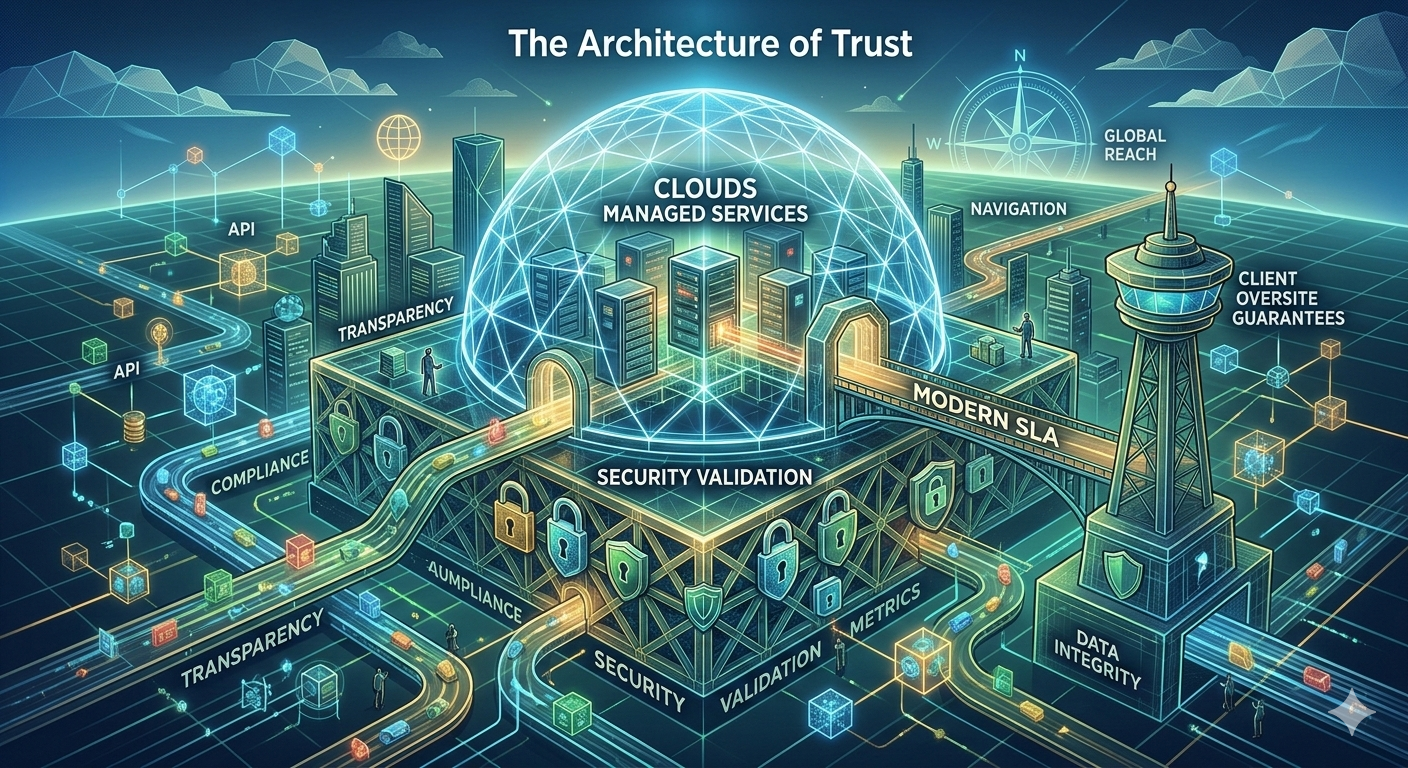
In the digital landscape of 2026, the “cloud” is no longer a destination; it is the very fabric of business operations. However, as organizations move toward complex multi-cloud and hybrid environments to power AI-driven workloads, the margin for error has vanished. For the modern enterprise, success is no longer about simply “being in the cloud”—it is about how that cloud is managed, secured, and held accountable.
To build a resilient digital foundation, leaders must master three distinct but overlapping pillars: Cloud Managed IT Services, proactive Security Testing, and the contractual rigors of the Cloud SLA.
Pillar 1: The Strategic Value of Cloud Managed IT Services
The days of internal IT teams spending 80% of their time on maintenance and “keeping the lights on” are over. In 2026, high-performing companies leverage Cloud Managed IT Services to shift their internal focus back to core innovation.
Beyond Maintenance: Predictive Management
Modern Managed Service Providers (MSPs) have moved beyond reactive troubleshooting. By utilizing AI-driven observability tools, they can predict a database failure or a traffic bottleneck before it impacts the end-user. This “self-healing” infrastructure is a hallmark of a mature managed service environment.
The Financial Shift: CapEx vs. OpEx
One of the most immediate benefits of managed services is the stabilization of IT spending. Instead of unpredictable capital expenditures on hardware refreshes every few years, businesses move to a predictable operating expense model. This allows for better cash flow management and the ability to scale resources up or down in real-time based on market demand.
Pillar 2: Security Validation—Pentesting vs. Vulnerability Scanning
As the complexity of the cloud increases, so does the attack surface. In 2026, automated bots are constantly probing for misconfigured S3 buckets or unpatched APIs. To defend against this, organizations must understand that “security” is not a single product, but a process of constant validation.
Vulnerability Scanning: The Automated Perimeter
Vulnerability scanning is your first line of defense. It is a broad, automated sweep of your network to find known weaknesses. Think of it as a security guard checking every door in a building to see if one is unlocked. It is essential for daily compliance and “security hygiene,” catching the low-hanging fruit that hackers often exploit.
Penetration Testing: The Human Element
While a scan finds the “hole,” penetration testing confirms if an attacker can actually use that hole to cause damage. A penetration test (or “pentest”) is an authorized, simulated attack performed by ethical hackers.
In 2026, pentesting is more critical than ever because it uncovers:
- Chained Exploits: How multiple minor bugs can be combined to gain administrative access.
- Business Logic Errors: Vulnerabilities that automated tools simply cannot see, such as bypassing a checkout process.
- Lateral Movement: How an attacker might move from a non-sensitive web app into your core financial database.
By combining the breadth of scanning with the depth of pentesting, businesses move from a “hope-based” security model to a “validated” one.
Pillar 3: The Contractual Backbone—SLA in Cloud Computing
If managed services provide the engine and security provides the armor, the Service Level Agreement (SLA) is the contract that ensures the vehicle reaches its destination. An SLA in cloud computing is the definitive document that outlines the expectations between the provider and the client.
Moving Beyond “Up-Time”
In 2026, a 99.9% uptime guarantee is the bare minimum. Modern SLAs must address the nuances of the user experience, including:
- Latency Thresholds: If your application is slow, it is effectively “down” for the user. Modern SLAs should guarantee response times in milliseconds.
- Incident Response Time: How fast will a human engineer respond to a critical failure?
- MTTR (Mean Time to Recovery): It’s not just about when the provider notices the problem, but how quickly they resolve it.
- Data Portability: An often-overlooked clause that ensures you can get your data out of the cloud if you decide to switch providers.
The Shared Responsibility Model
It is a common misconception that the cloud provider is responsible for everything. Under the “Shared Responsibility Model,” the provider secures the infrastructure (the physical data centers and hardware), while the client—often through their managed service partner—is responsible for securing the data and applications within that infrastructure.
Best Practices for 2026: The Integrated Approach
To maximize ROI and minimize risk, organizations should not view these three pillars in isolation. Instead, they should follow this integrated workflow:
| Step | Action | Objective |
| 1. Architect | Partner with a Cloud Managed Service provider. | Create a scalable, AI-ready environment. |
| 2. Secure | Implement continuous Vulnerability Scanning. | Maintain high-level security hygiene. |
| 3. Validate | Schedule annual or bi-annual Penetration Testing. | Prove that your defenses can withstand a real attack. |
| 4. Govern | Review and update your Cloud SLAs. | Ensure contractual accountability for all performance metrics. |
Conclusion: Building for the Future
The transition to the cloud was the challenge of the last decade. The challenge of this decade is managing the complexity that the cloud has created. By leveraging specialized Cloud Managed IT Services, distinguishing between Vulnerability Scanning and Penetration Testing, and demanding rigorous SLAs, businesses can transform their IT from a cost center into a powerful engine for growth.
In 2026, resilience isn’t just about avoiding failure—it’s about building a system that can recover, adapt, and thrive regardless of the challenges it faces.
 Qasim Bhai