


Introduction
The ever-competitive environment and technological advancements for modern manufacturers create a situation where choosing between tapping and milling in thread machining is a matter of utmost concern and needs to be addressed effectively. Making a wrong decision can lead to machine failures, cost overrun, and sometimes quality failures. This situation has led to situations where decisions have to be based heavily on experience and practical expertise.
The current article is a comprehensive guide for manufacturers to take effective decisions regarding machine tools. It is backed up by standard sources. The coming sections will discuss in detail various factors to enable the reader for effective decision making.
What Are the Fundamental Differences Between Tapping and Milling in Thread Machining?
Tapping and milling are two very different methods for thread machining, and there are distinct principles and costs associated with each. This is very important to recognize in understanding which process can be applied for a certain need.
1. Basic Principles and Tooling Mechanisms
Tapping requires the use of a tap to create threads in a pre-drilled hole by moving linearly. On the other hand, thread milling requires the use of a CNC milling machine end mill to create the holes by moving helically. In terms of cost, tapping tools are less expensive to purchase at first. However, milling tools last longer. Additionally, the milling tools require less changeover time. These factors will end up influencing efficiency.
2. Cost and Flexibility Considerations
The tooling investment for tapping is often lower, but it lacks flexibility for non-standard thread sizes or materials. Milling, while requiring higher upfront costs for CNC programming and equipment, enables quick adjustments to thread parameters without tool changes. Reference to the ASME Y14.5 standard highlights the importance of geometric tolerances, whereby milling excels in maintaining precision across variations as discussed in resources on tapping vs. milling.
3. Accuracy and Application Scenarios
Tapping is great for high-volume simple threads where speed is a priority, but it may not be able to hold very tight tolerances. Milling, assisted with sophisticated CNC systems, offers the finest accuracy for intricate pieces, such as in the aerospace industry, according to standards like ASME Y14.5-2018. That makes milling a favorite when applications require stringent dimensional control.
How Does Material Properties Influence the Choice Between Tapping and Milling?
Material properties like hardness and machinability are playing a crucial role in identifying the best machining process for thread production. Incorrect machining methods may result in the failure of tools, thus highlighting the importance of the quality-oriented approach.
Insert an image to make a visual statement.
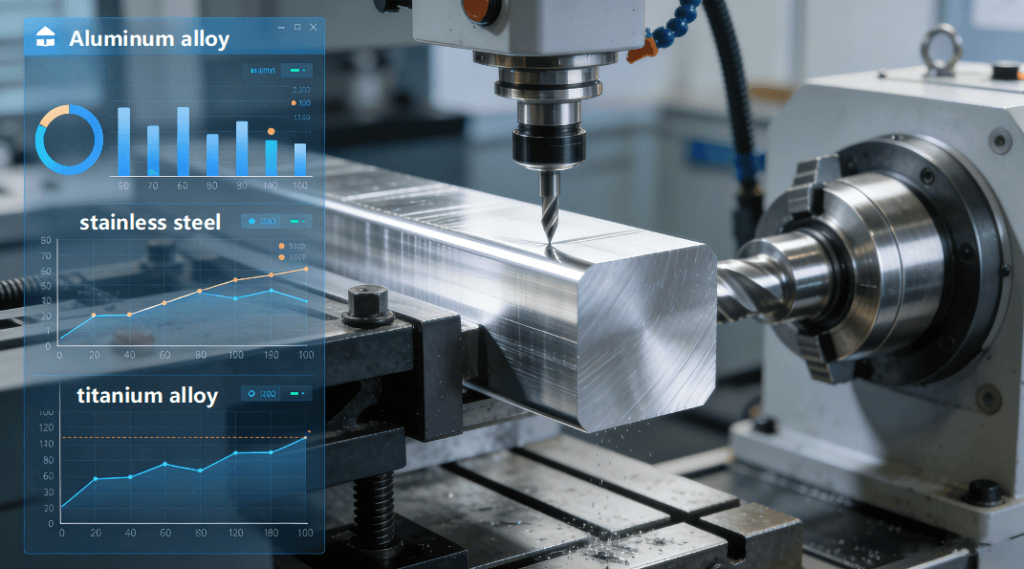
- Effect of Hardness & Ductility:Softer materials with low strength such as aluminum are suitable for the process of tapping, while milling should be used for hard materials such as titanium to prevent the breakage of the tool and work hardening. For example, when making medical devices, the process of milling prevents the hardening of brittle materials, which ensures the integrity of the threads. A quality management system following ISO 9001 ensures material handling.
- Case for Material-Specific Optimization:In the context of components made up of stainless steel, it was observed in a case study that changing from turning to milling brought down the incidence of tool breakage by 40% in hard materials. This example exemplifies the influence of material characteristics on process selection, where materials like stainless steel are better suited to machining processes such as milling. ISO standards can help manufacturers record such process improvements.
- Efficiency and Tool Life Trade-off: While deciding between tapping and milling operations, tool life and rate of production need to be considered. In the automotive industries, for instance, tapping can be preferred for large numbers of aluminum materials. However, for titanium alloys, milling will remain the most economical process due to increased tool life. Confirming to a standard such as ISO 9001:2015 will help in such matters.
What Cost Factors Should Be Evaluated for Tapping vs Milling Decisions?
A detailed cost analysis is required to justify the difference in tapping vs milling, taking into consideration tool costs, cycle time, and set up.
1. Tool Life and Maintenance Costs
Tapping tools could have lower up-front costs but would need to be replaced from time to time in abrasive materials. This would increase costs. Milling inserts are more expensive but have higher durability and can even be refurbished. Lifecycle assessments on total tool life correspond with cost-effective tapping milling from a cost-saving perspective.
2. Cycle Time and Labor Implications
Tapping is known to have faster cycle times for simple threads, and milling reduces non-cutting time through multiple-axis processing. In a production setting, milling’s ability to perform multiple operations reduces labor cost, amounting to a possible 30% saving, according to industry reports. For optimal processing, one may turn to specialized services to have this conflict analyzed.
3. Setup and Overhead Costs
Although tapping requires less complexity in tapping setups, which results in low initial investment, a single-step process of milling reduces setup fixture expenditures; in addition, because of value engineering, taking into consideration the unit cost of milling vs tapping, it is noticed that milling will be an effective process when flexibility exceeds delay.
In What Ways May Requirements for Precision Influence a Choice Between Tapping and Milling?
Varying precision standards like a tolerance of ±0.01mm affect the procedure of thread machining, where milling is preferred due to its accuracy.
1. Degree of Tolerance and Geometric Control
Milling operations allow precision within tight tolerances using programmable tool paths. This ensures industries such as aviation require ASME Y14.5 compliance. Tapping is also satisfactory. However, there may be variations in precision when carried out in deeper holes. CNC programming guidelines help in precision during milling operations.
2. Error Reduction and Quality Assurance
CNC milling services process can effectively reduce error accumulation, thereby promoting uniformity in thread production. Taking companies with AS9100D certification as an example, they have significantly improved product reliability through the large-scale application of milling technology. This is a major advantage in cases where risks for deviation are higher.
3. Adaptability to Complex Designs
The flexibility in milling made possible by CNC technology enables dynamic compensation during the machining process for complex geometries, including tapered threads. In tapping, there is a lack of flexibility in machining, making it necessary to have other machining operations in addition to tapping. The benefit of emphasizing technical decision-making guidelines enables the manufacturer to consider machining using milling when it is for prototyping or low production volumes.
What Are the Best Practices for Implementing Tapping or Milling in High-Volume Production?
For tapping and milling processes intended for mass production, management practices with high ROI must be adopted regarding scalability.
- Tool Management and Maintenance Schedules: In the use of tapping tools, the application of preventive maintenance through practices such as lubrication checkup cuts down on downtime. In milling operations, the application of tool life monitoring maximizes the replacement cycle, thus increasing efficiency. Research by McKinsey highlights the potential of 25% reduced costs through proactive care, particularly when the volume is high.
- Hybrid Strategies for Optimization: A combined process, involving tapping for standard threads and milling for complex sections, offers a balance between speed and accuracy. For example, in the field of consumer electronics, it enabled a streamlined process during assembly, resulting in a reduction of 20% in costs. These practical case studies fully demonstrate that customized solutions can significantly improve the efficiency of thread machining operations.
- Efficiency Metrics and Continuous Improvement: The use of metrics such as OEE (Overall Equipment Effectiveness) helps optimize processes. Conducting audits in accordance with ISO 9001 Standards helps in making decisions related to the tapping mill process. The decision will be based on continuous improvement.
How Do Industry Standards Such as ISO and ASME Affect Decisions on Tapping vs Milling?
Observance of global norms helps to establish that the machining of threads for reliability and compliance requirements falls within the required standards.
1. Role of Quality Management Systems
Standards such as ISO 9001 require documented processes for thread machining. Milling traceability benefits here, as it helps industry players comply with requirements. Including these standards in decision-making tools and methodologies recognizes the importance of a systematic approach.
2. Environmental and Safety Concerns
ISO 14001 is strongly focused on sustainable processes, making it a better choice due to waste reduction compatibility. ASME guidelines, like those of Y14.5, present tolerance needs, which are easily satisfied by milling, leading to optimization of processes without negatively impacting safety.
3. Certification as a Decision Driver
Car industry certifications such as IATF 16949 will necessarily mandatorily include requirements related to validated processes where milling’s accuracy becomes a distinct advantage. In talking about these sources, it becomes easy to move towards conclusionary observations.
Conclusion
In conclusion, the decision between tapping and milling is dependent on a cost-sensitive and material-considerate analysis. With the systematic approach described in this document—from differences in principle to compliance with standards—sustainable improvements in production are possible. Start the journey with this guide to tailor your own analyses for the best possible thread machining results.
FAQs
Q: What would you say is the greatest advantage in milling threads over stainless steel compared to tapping?
A: Thread milling imparts less work hardening in stainless steel with the use of lower cutting forces to enable higher precision and longer tool life than tapping can allow for. This is critical for medical and aerospace applications where material integrity is paramount.
Q: How can I calculate the cost savings when switching from tapping to milling?
A: Apply Value Engineering that takes into account such factors as tool life, cycle time, and scrap rates. Some manufacturing companies offer free process evaluations, calculating the return on investment based on production volume and material characteristics.
Q: Which process is more accurate for deep hole threading?
A: Milling is done for deep holes due to better chip removal with lesser chances of tap breakage. It has achieved a tolerance within ±0.01 mm with the use of a programmed helical path.
Q: How can a balance be struck when accuracy and cost are involved in the thread machining process?
A: Use a hybrid strategy where tapping can be employed for high-volume simple threads and milling for low-volume complex components. Use ISO standards for referencing tolerance benchmarks with budget.
Q: Can you give examples for successful tapping vs. milling process optimization?
A: A case study at a manufacturing company focusing on engine cylinder heads showed that using milling (instead of turning) to machine aluminum alloy materials resulted in a 300% increase in tool life and a 30% cost saving. This case study has been documented under the AS9100D process standard.
Author Bio
The author is a precision manufacturing expert at LS Manufacturing. They are a company that assists engineers and researchers in dealing with difficult part design issues. This is done through high-quality solutions that involve advanced technology. They are certified and include IATF 16949 and AS9100D. To gain more information on precision manufacturing, do not hesitate to contact them. Create a cost-effective solution from your concept.
 Qasim Bhai