

Introduction: The “Profit-Per-Mile” Illusion
Friday night. Gas station lights buzzing. The pump handle clicks as numbers spin faster than you’d like. The delivery app on your phone says you made $150 today. Sounds decent—until the screen at the pump settles on $45. Insurance, oil changes, tires, and depreciation don’t even show up in that moment, but you know they’re coming.
This is the profit-per-mile illusion. Gig apps love to show revenue. They almost never show what it costs to earn it.
Driving a 3,000-pound car to deliver food, groceries, or hardware is an economic mismatch. Every mile costs fuel. Every stop adds wear. Every parking mistake risks a ticket that can erase a whole shift’s profit. In the gig economy, your vehicle isn’t just a tool—it’s your biggest liability.
Smart earners eventually realize this isn’t about working harder. It’s about changing the math. The only real way to win is to opt out of the gas trap entirely and move toward high-capacity micro-mobility that slashes overhead to near zero.
Why “Last Mile” Logistics Is a Trap for Cars
Most delivery money is lost in the last mile.
Downtown delivery is a stress test for cars. Double parking invites tickets. Parking garages turn a short drop-off into a five-minute walk. Congestion turns a two-mile route into a twenty-minute crawl while the timer on your app keeps ticking.
Cars pay for every inefficiency.
Two wheels don’t. A bike rolls to the front door. No circling the block. No parking garages. No tickets wiping out a day’s earnings. Saving five minutes per order doesn’t sound dramatic—until you multiply it.
Over an eight-hour shift, saving five to ten minutes per delivery easily turns into two extra hours of earning time. That’s not theory. That’s how hourly profit quietly doubles without taking more orders.
This is where the agility of an electric dirt bike becomes a financial advantage, not a lifestyle choice.
Alleys, service roads, park connectors, construction cut-throughs—cars can’t touch them. Bikes flow through the city’s hidden veins, turning geography into an asset instead of a problem.
The “Volume Strategy”: Moving Beyond Burritos
Food delivery is easy money—and that’s exactly why it pays the least.
The real profit in micro-delivery comes from volume and weight. Grocery orders. Hardware store runs. Pharmacy batches. These jobs stack better and tip higher, but they expose weak setups fast.
Try carrying three bags of groceries, a case of bottled water, or a 40-pound bag of cat litter on a flimsy scooter. The frame flexes. Handling gets sketchy. Hills turn into slow, overheating climbs.
Physics doesn’t care about hustle mindset. Weight demands torque. Stability matters more than speed. A low center of gravity keeps the bike predictable when loads shift. Wide tires prevent wobble when you’re riding over cracked pavement, curb cuts, or gravel parking lots.
Light commuter bikes were never built for this. Volume work requires something closer to a mule than a racehorse.
Hardware Requirements: Choosing the Right Tool
This is the only section where hardware gets named—because at this level, equipment either supports the business or kills it.
To replace a car, a delivery rig needs three things:
Torque for hills.
Single motors struggle when you add 40–50 pounds of cargo and point uphill. Heat builds fast. Power drops. You end up crawling or walking. Dual motors distribute the load, keeping output stable instead of spiking.
Range for real shifts.
A four-hour shift drains standard batteries quickly. Stopping to recharge means lost income. Endurance isn’t a luxury—it’s uptime.
Modularity.
Delivery work isn’t one-dimensional. One hour you’re hauling boxes. The next, you’re giving a short ride or running a personal errand. Swapping setups quickly matters.
This is where a specialized off road electric bike with cargo capability becomes a business asset, not a toy.
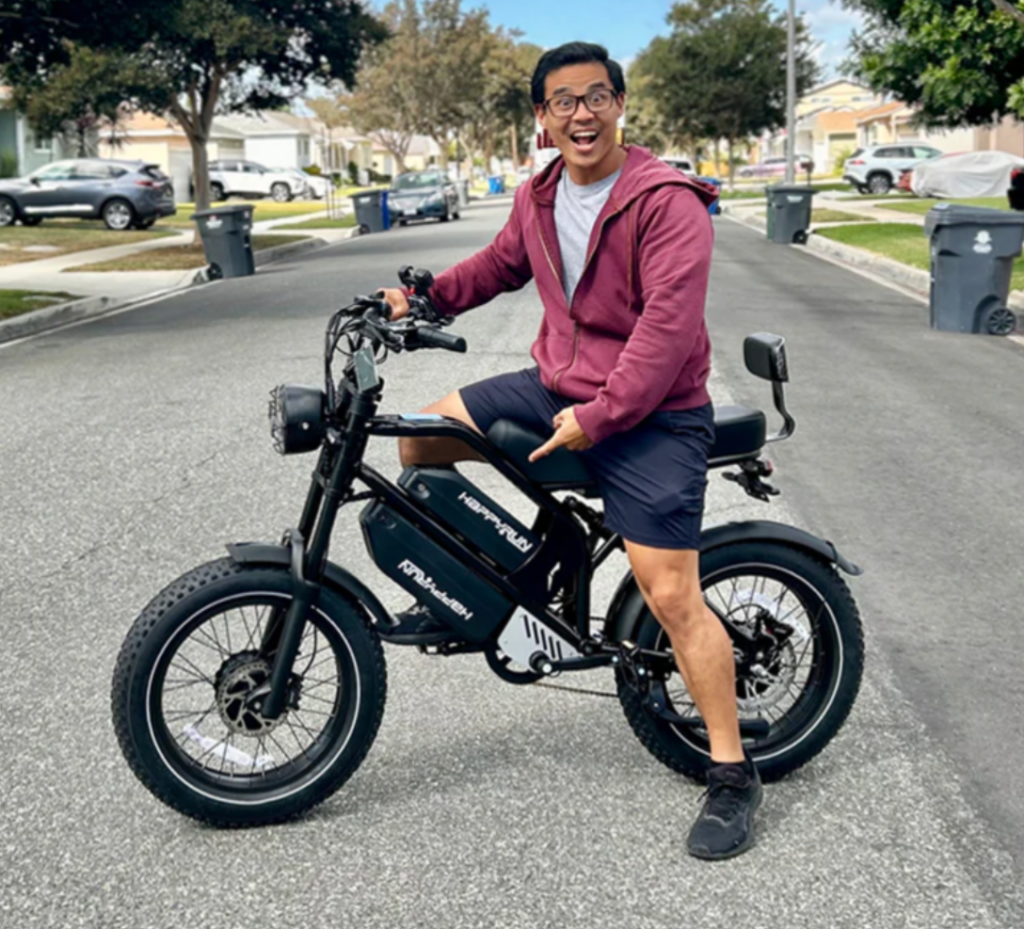
A practical case study is the HappyRun G70 Pro.
Why it works for heavy hauling isn’t branding—it’s mechanics. The dual-motor system with 5,000W combined peak power doesn’t stall when climbing driveways under load. Power is shared, heat is reduced, and momentum stays predictable. The 48V 33Ah dual-battery setup isn’t about headline range—it’s about finishing a full workday without heading home early.
The removable rear seat is another quiet advantage. During work hours, it becomes cargo space. On weekends, the seat goes back on. One machine, two roles. That flexibility is how tools earn their keep.
Then you move on. No hype needed.
The “All-Terrain” Income Stream
Weather separates casual riders from earners.
Rain, snow, and cold thin the field. Orders surge while drivers stay home. This is where preparation pays. Fat tires maintain grip on slick pavement. Full suspension absorbs potholes hidden under puddles. Construction detours become shortcuts instead of hazards.
Standard road bikes fail here. Scooters struggle. Rugged e-bikes keep rolling.
The mindset matters as much as the machine. While others wait for clear skies, prepared riders clean up high-paying orders with less competition and better tips.
Conclusion: Calculating Your New ROI
The gig economy only works if you control your costs.
Lower overhead. Higher volume. Better access. That’s the formula. If switching to two wheels saves $50 a week in gas and lets you complete just three extra deliveries per shift, the math adds up fast. In months—not years—the investment pays for itself.
This isn’t about riding for fun. It’s about making deliberate business decisions.
Do the math on your own mileage. Look at what you actually keep after expenses. You might discover that ditching the car isn’t a downgrade—it’s the biggest raise you can give yourself.
 Shaban Ch