

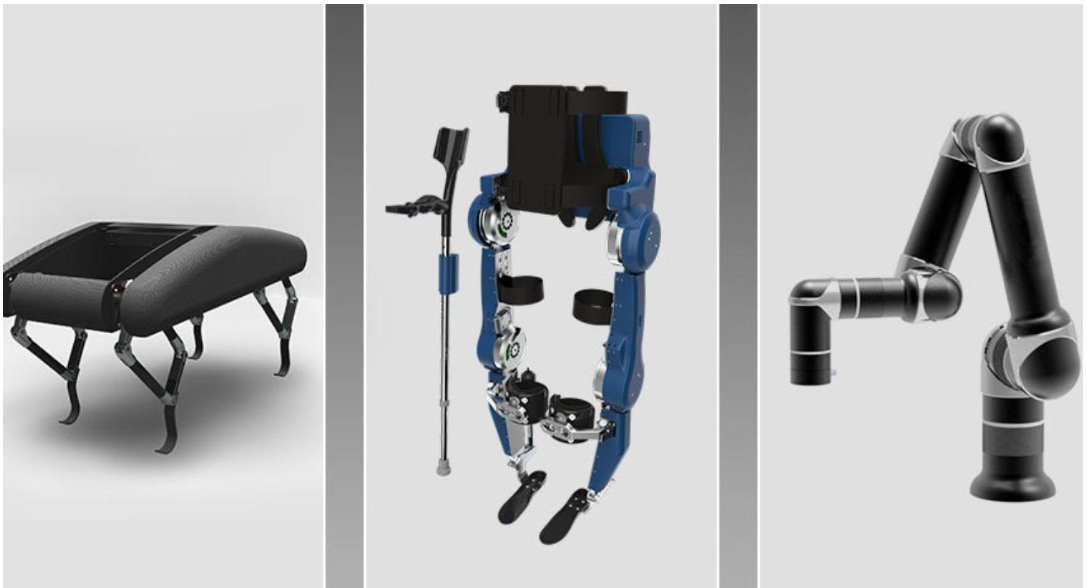
Humanoid robots are engineered to be able to replicate human movement and interaction. In order to have this kind of complexity, engineers are depending on the use of the very advanced motors that can mimic the natural human movements without loss of precision, stability, and efficiency. Such motors are the main elements that drive the robotic joints, which can be shoulders, elbows, hips, knees, and wrists. In the absence of reliable and high-performance motors, humanoid robots could not carry out such important tasks as walking, holding objects, or keeping their balance. The explanation of the main characteristics of the Humanoid Robot Motor can be used to emphasize the fact that humanoid robots can execute more and more complex tasks.High Torque Density for Powerful Movement
High torque density is one of the most essential features of motors in humanoid robotics. Torque density is the unit of torque that can be generated by a motor with respect to its size and weight. Humanoid robots have high-power motors to move their limbs, transport goods, and maintain stability when doing activities like walking, running, or climbing.
The value of high torque density is that robotic motors are capable of producing large amounts of power without the motor increasing in size. This is highly relevant in the case of humanoid robots since the size of their joints should be small yet strong enough to allow complicated movements. A high-torque density allows the creation of a robot that is able to complete physically challenging jobs and still have a lightweight frame.
Torque motors are used in conjunction with gear reduction systems to increase the output torque further in a number of advanced robotic systems. Such a combination enables humanoid robots to be more efficient in their actions, including lifting, pushing, and balancing.
Lightweight and Compact Design
Lightweight and compact design is another important characteristic of the motors in humanoid robotics. Humanoid robots are normally fitted with a series of motors that are located in their joints. Assuming that the motors were large or hefty, then the entire robot would be bulky and inefficient in nature.
Lightweight motors assist in lowering the overall weight of the robot, which enhances agility and energy efficiency. The lighter the limbs of a robot are, the easier it is to control the movement and balance. It is critical to the stability of two-legged robot design, and it is particularly important to robots that are to be used to negotiate rough surfaces such as gravel beds, etc.
The small motor designs also enable the engineers to incorporate motors in the joints of robots. This integration assists in designing more natural and human-like motion, and mechanical complexity is minimized. With this, the robot is able to move more quickly and react to control signals.
Integrated Actuator Systems
There are usually actuator systems built into modern humanoid robot motors. An actuator is usually designed to contain a number of elements in one part, such as the motor, gearbox, encoder, and motor driver. This integration makes the design of robot systems easier and enhances performance.
Robotic actuators eliminate the use of more external parts in the system by incorporating several components into a single small unit. This saves space as well as enhances reliability. The reduced number of external connections implies that the probability of mechanical breakdown or interference with signals is reduced.
Robotic systems are also easier to maintain and manufacture with the help of integrated actuators. The single module allows engineers to install the module rather than connecting several distinct modules, thereby making the development fast and making the design less complex.
Precision Control and Feedback Systems
Another important characteristic of motors that are utilized in humanoid robotics is precision control. Humanoid robots have to do very fine work, like picking up things, communicating with people, or changing their body positions, so that they do not fall. The motor control in these actions is very critical.
In order to attain this degree of accuracy, the robotic motors employ sophisticated means of feedback, like encoders. Encoders are able to determine the precise position, speed, and rotation of a motor shaft so that the control system can regulate movement in real time.
Encoders that are highly precise provide smooth and precise movement of the joint. This enables the robot to do complicated tasks like coordinated arm movements or a steady gait. Proper feedback also serves the purpose of avoiding abrupt or jerky movements, which would cause the robot to lose balance or break its mechanical parts.
Multiple Control Modes for Flexibility
Motors in humanoid robotics typically have more than one control mode, such as force control and servo control. The control methods enable the engineers to tune the behavior of the motor to suit the activity the robot is accomplishing.
Servo control mode is aimed at accurate position and speed control. It is responsible for making the motor move to an angle or position with a high degree of accuracy. It is specifically helpful with those tasks where there should be control and repetitiveness in movement.
Force control mode, on the other hand, gives the motor control over the level of force that is exerted when getting in contact with objects or surfaces. This functionality is necessary whenever robots are working with delicate objects or when they are working with human beings.
Robot motors can offer high flexibility and adaptability in a large variety of applications by supporting a wide range of different control modes.
Durability and Impact Resistance
Humanoid robots usually have to work in dynamic and unpredictable conditions. Consequently, the motors in such systems should be robust and have the capacity to resist mechanical strain. Good robotic motors are engineered using hard materials as well as specialized bearings that are capable of supporting repeated motion as well as sudden impacts.
The ability to last longer is particularly required of joints like the knees and hips that are prone to heavy loads when walking or jumping. Motors used in such applications should not change their performance after long periods of use.
Components that are impact-resistant are used to cushion the motor and other mechanisms around it. This will make humanoid robots work effectively under real field conditions regardless of whether they are applied in research, industries, or service operations.
Conclusion
The motors are the key to enabling humanoid robots to move, communicate, and do convoluted jobs. High torque density, lightweight design, built-in actuator systems, precise feedback sensors, flexible control modes, and robust construction are some of these features that make robotic motors effective.
With the ongoing enhancement in robotics technology, it is found that the specialization of the motors will still be a major consideration in enhancing humanoid robots. Manufacturers such as CubeMars and other companies involved in designing and building humanoid robots are constantly advancing the technology of motors with innovation and engineering know-how, making humanoid robots more competent, efficient, and adaptable to practical uses.
 Shaban Ch
  Qasim Bhai