

Rhinoplasty is also known as a nose job. It could enhance facial harmony and was developed to cure breathing disorders while giving an awesome shape to the nose. There are generally two approaches in Toronto: open and closed rhinoplasty. Both methods can lead to transformative results, but they differ in the technique, benefits, healing process, and results. In order to choose which rhinoplasty in Toronto suits you, this guide explains the differences so you’re well-informed about your choice.
What Distinguishes an Open Rhinoplasty from a Closed One?
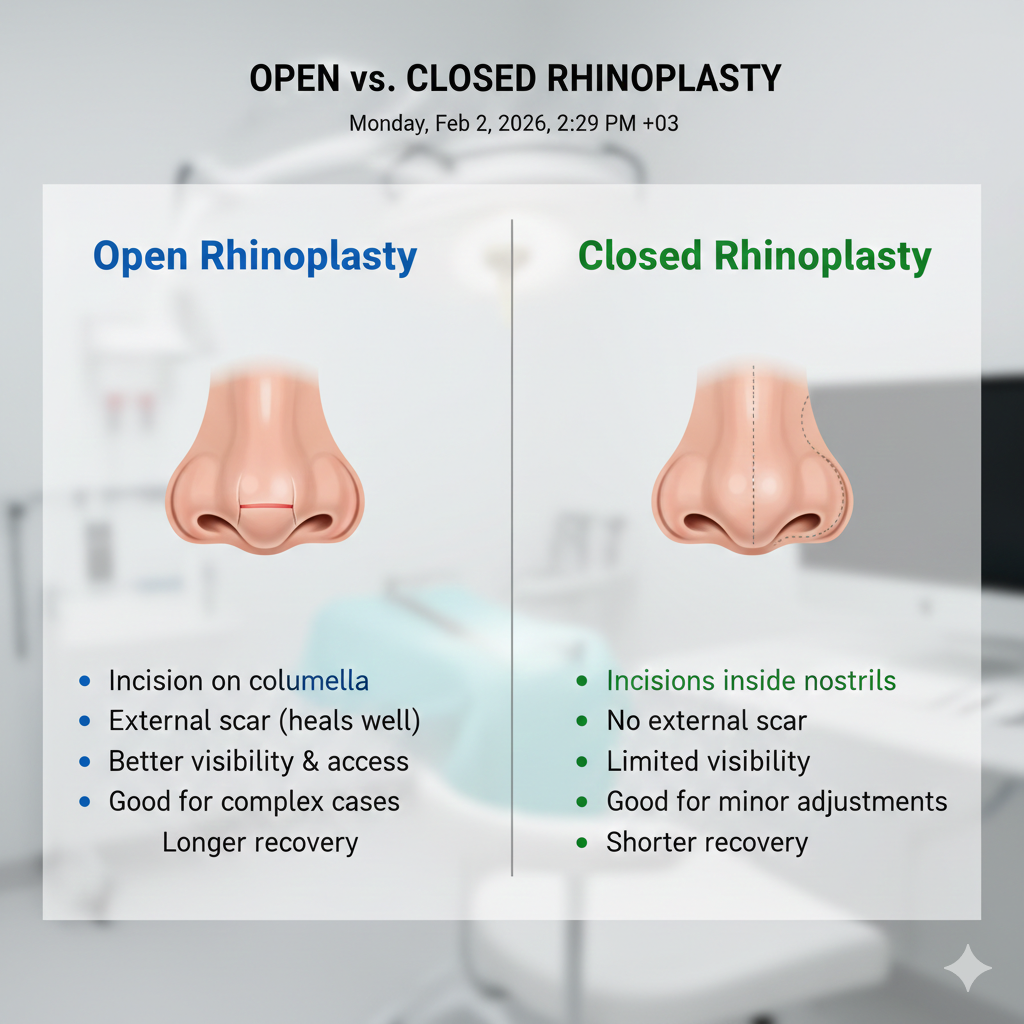
There are two major differences between the methods of open and closed rhinoplasty; these depend on surgical technique and the pattern of incisions made. In an open approach to rhinoplasty, an external incision has to be made from one nostril to the other along the columella, a strip of tissue that connects the two. The access this gives allows direct visualization of the nasal structure and, ultimately, permits the surgeon to reshape and even quite significantly alter its structure. Closed rhinoplasty approaches the nasal structure from the inside out. All incisions are made within the nostrils, and no external scarring is evidenced.
Each of these procedures has its own merits and demerits, and the best choice typically is dependent upon the extent of the procedure, what the patient wants to achieve with the surgery, and the kind of changes they want.
What Are Closed and Open Rhinoplasty Techniques?
- Closed Rhinoplasty: In closed rhinoplasty, the nasal structure is accessed by making incisions within the nostrils without producing visible scars. Closed rhinoplasty is less invasive and is mostly used for patients who require minor adjustments to their nasal bridge, tip, or nostrils. Generally, closed rhinoplasty is preferred as the procedure of choice for primary rhinoplasty, where reshaping is merely minute and subtle.
- Open Rhinoplasty: This technique involves making the incision across the columella, where the surgeon raises the nasal skin to let him access the nasal structure quite easily. This approach is usually implemented in more complex reshaping and structural changes, such as in cases of revision rhinoplasty, main tip refinement, or more significant adjustments of the nasal bridge. Open rhinoplasty is used because it gives the surgeon a surgeon a clear view and control over structures, especially when used in complex procedures.
Both techniques should be undertaken by a highly experienced rhinoplasty surgeon for effective outcomes. Most patients, especially those in Toronto, visit a specialist to learn which technique is better suited for their goals.
Benefits of Open and Closed Rhinoplasty
The advantages of each method differ and are specific to the needs of the patient:
- Benefits of Closed Rhinoplasty:
- Less Invasive: The closed rhinoplasty procedure has less invasion since no external incisions are required.
- Shorter Recovery Time: Patients who undergo closed rhinoplasty usually tend to have shorter recovery periods with less swelling and bruising.
- No Visible Scars: All incisions are made within the nostrils; thus, there are no visible scars, which might attract some people seeking a smooth look.
- Benefits of Open Rhinoplasty:
- Greater Information for Advanced Procedures: An open rhinoplasty provides a surgeon with an unobstructed view of the nasal profile, thus enabling him to make very precise alterations to achieve more refined sculpting.
- Best suited for Structural Modifications: Individuals requiring more profound modifications, such as complete refinement of the tip or modification of the bridge, may best benefit from open rhinoplasty since there is also better visualization and control.
- Open rhinoplasty is usually the first choice for people who need revision surgery to correct or enhance a previous rhinoplasty.
There is one suitable use in each, and this information will be better geared toward equipping Toronto patients with their choice when discussing it with a surgeon.
How Do Both Open and Closed Rhinoplasty Healing Processes Go?
Each rhinoplasty technique heals and recovers differently because each has its timeline and experience:
Closed Rhinoplasty Recovery
- Shorter Down Time: Closed rhinoplasty usually requires short periods because it is not invasive.
- Less Swelling: Patients experience less swelling and bruising; hence, the healing process is faster and easier.
- Rapid Return to Normal Activities: Most patients return to normal activities within a week or two; most of the swelling would have faded by that time.
Open Rhinoplasty Recovery:
- It typically requires more time for recovery because the tissue manipulation is greater in this open rhinoplasty as there is an incision outside the nose.
- The swelling and bruising would be more noticeable in the first weeks after the treatment. It would take several months before the swelling is completely dissipated and the final configuration is achieved.
- Gradual Improvement: While the swelling from major swelling can be reversed in a few months, subtle improvements continue for a year.
A patient in Toronto can anticipate becoming active, little by little, and full results are revealed after some time, more specifically, for open rhinoplasty. Both methods will need postoperative care instructions to be followed so swelling is reduced, and the result is enhanced.
How Do the Outcomes of an Open Rhinoplasty Differ from Those of a Closed One?
Both closed and open rhinoplasty techniques can result in natural-looking results; the results, however, depend on whether the procedure is invasive or not:
Results From Closed Rhinoplasty:
- Detailing over the Minimal: Closed rhinoplasty is great for smaller modifications, such as a slight bridging refinement or tip-point adjustments that do not alter the original configuration of the patient.
- Well-Coordinated with Facial Contour: A closed rhinoplasty has balanced results, especially when not much structural alteration is needed in the patient’s face.
- Suitable for Candidates Who Have Never Experienced a Surgical Procedure: If you are looking for a subtle change, closed rhinoplasty will be sufficient and result in satisfactory changes with minimal alterations.
The outcome of Open Rhinoplasty
- Extensive and Intricate Outcomes: Open rhinoplasty allows for a more detailed change, and results typically tend to be the most dramatic reshaping and refinement.
- Permanent Improvements to the Structure: An open procedure will often result in significant alteration of the nasal tip and bridge, resulting in more stable, long-term outcomes and withstanding better against systemic effects of aging.
- Good for Revision Rhinoplasty: The open approach provides the patient with the needed visibility and accuracy for correction of prior problems under revision rhinoplasty, offering results that are refined and natural.
The choice between open and closed rhinoplasty in Toronto will depend on how much you want to change, how complex your procedure will be, and what your surgeon recommends. Open rhinoplasty is used when significant changes are required, while people opting for minor improvements prefer closed rhinoplasty.
Deciding on the Right Rhinoplasty Approach: Making the Choice
The choice between open and closed rhinoplasty is a very crucial decision that will determine the outcome of your operation. There are various techniques, and the suitability of any one approach will depend upon your desired outcome, anatomy, and expectations. The best technique would be to consult with an experienced rhinoplasty specialist in Toronto. Understanding the differences between open and closed rhinoplasty will help a patient be well-informed, feel confident in their decision, and be prepared to realize the results they so desire with the correct technique and qualified surgeon.
 prime star