

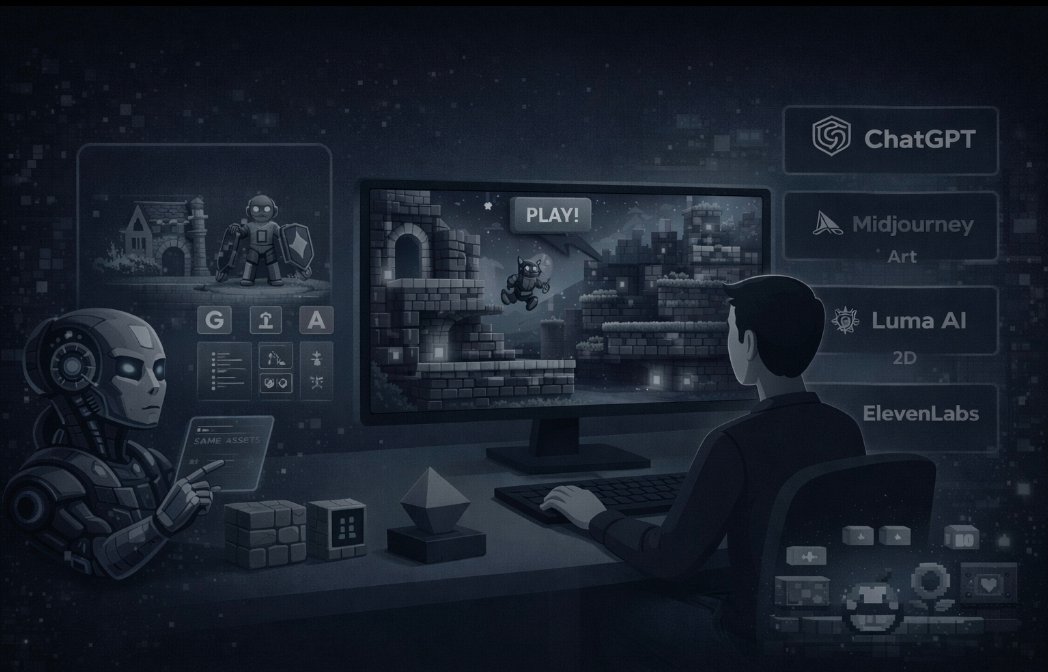
You might attribute this to luck or coincidence. In reality, it is often the work of sophisticated software working quietly in the background.
AI in gaming has evolved far beyond controlling the pathfinding of enemy soldiers or the strategy of a chess bot. Today, Artificial Intelligence acts as the architect of the experience. It serves as an invisible “Game Master,” monitoring your performance, enforcing the rules, and subtly tweaking the world around you to ensure you stay engaged.
While flashy graphics and narrative writing get the credit, it is often this invisible layer of AI that determines whether a game feels “fair” or “fun.” By managing game rules and player progression in real-time, developers are creating experiences that feel uniquely tailored to every person holding a controller.
The Role of AI as the “Dungeon Master”
In Tabletop Role-Playing Games (TTRPGs) like Dungeons & Dragons, a Dungeon Master (DM) sits at the head of the table. They don’t just control the monsters; they decide the outcomes of actions, ensure the rules are followed, and adjust the story if the players are struggling or breezing through.
In modern video games, AI fulfills this exact role.
Traditionally, game rules were hard-coded. If a player touches a spike, they lose 10 health points. This static approach works for simple platformers, but complex open-world games require a more nuanced touch. Now, AI monitors the environment to enforce physics and logic systems dynamically.
For example, an AI system might calculate if a player’s movement speed combined with the terrain angle allows for a successful jump, rather than relying on a pre-scripted “jump zone.” It acts as an impartial referee, constantly validating the state of the game world to ensure that the rules remain consistent, even as the player interacts with the environment in unpredictable ways.
Dynamic Difficulty Adjustment (DDA)
One of the most powerful tools in a developer’s arsenal is Dynamic Difficulty Adjustment (DDA). This is the process by which a game automatically modifies its difficulty level in real-time based on the player’s ability and performance.
The goal of DDA is simple: keep the player engaged. If a game is too hard, players quit out of frustration. If it is too easy, they quit out of boredom. DDA seeks to find the perfect middle ground.
How DDA Works
Instead of selecting “Easy,” “Medium,” or “Hard” at the start of a campaign, the AI builds a profile of the player based on live metrics. The system tracks specific data points, such as:
- Accuracy: How many shots are hitting the target?
- Survival Rate: How often does the player die or take damage?
- Time to Completion: How long is the player lingering in a specific area?
- Resource Management: Is the player hoarding inventory items or running on empty?
Based on this analysis, the AI subtly adjusts variables in the game. Enemy health might decrease slightly, aggressive behaviors might tone down, or essential resources like health packs might spawn more frequently.
Examples in Action
The survival horror classic Resident Evil 4 is famous for its hidden DDA system. If the player is landing headshots and moving through levels efficiently, enemies become faster, stronger, and more aggressive. If the player dies repeatedly or misses shots, the enemies slow down and deal less damage. The game never tells you this is happening; it simply adjusts to make you feel challenged but capable.
Similarly, Left 4 Dead utilizes a system called “The Director.” This AI monitors the stress levels of the players. If the team is being overwhelmed by zombies and taking heavy damage, the Director holds back the next wave. If the team is cruising through the level with high health, the Director ramps up the tension by spawning a boss or a massive horde. The result is a unique pacing curve for every single play session.
Even small, over‑the‑top arcade experiences, like Super Saiyan Lawn Saga, where you mow lawns with explosive ki blasts, can benefit from similar systems that watch how overwhelmed you are and subtly tune enemy pressure or resource drops to keep runs tense but survivable.
Managing Player Progression and Pacing
Beyond moment-to-moment difficulty, AI is instrumental in managing the long-term progression of a player. This involves keeping the user in the “Flow State”, a psychological zone where a person is fully immersed in a feeling of energized focus.
Balancing Loot and Rewards
In Role-Playing Games (RPGs) and “looter-shooters,” the distribution of rewards is critical for retention. If a player goes too long without a meaningful upgrade, they may feel their time is being wasted.
Adaptive game mechanics can monitor player engagement and “churn risk.” If the AI detects that a player’s session times are dropping or they are struggling to progress, it can manipulate the probabilities of loot drops. Suddenly, that legendary sword the player has been hunting for weeks finally drops. This isn’t random; it is a calculated decision by the progression AI to re-engage the player and validate their effort.
Skill-Based Matchmaking (SBMM)
In multiplayer environments, AI manages progression through matchmaking. To ensure a fair competitive ladder, algorithms analyze a player’s skill rating, win/loss ratio, and even reaction times. The AI then groups players of similar skill levels.
While often debated in gaming communities, effective SBMM is essential for player retention. It ensures that new players aren’t immediately crushed by veterans (which would halt their progression) and that veterans aren’t bored by stomping novices. The AI game creation tool creates a protected environment where progression feels earned.
In anime‑inspired arena fighters game created by using AI game development tool which dont eed any code knowledge, like Naruto battles on platforms such as Astrocade, similar AI‑driven systems could keep matchups fair and exciting by pairing players of comparable skill and subtly tuning rules around damage, cooldowns, or round length.
Procedural Narratives and Personalized Rules
As we look toward the next generation of gaming hardware and software, AI game mastering is set to become even more sophisticated. The integration of Generative AI suggests a future where not just the difficulty, but the rules and narrative themselves, adapt to the user.
We are moving toward systems where:
- Moral Choices Impact Mechanics: If a player consistently chooses violent options in dialogue, the AI might dynamically shift the game’s rules to favor combat proficiency over stealth or diplomacy, effectively rewriting the character’s progression tree on the fly.
- Hyper-Personalization: Games could create unique challenges based on a player’s specific psychological profile. If the AI learns that a player enjoys exploration but hates puzzles, it could procedurally generate a dungeon that is massive and sprawling but light on logic traps.
Prompt-based game generation Platforms like Astrocade already hint at this future, letting anyone describe ideas in natural language and instantly spin up casual, shareable games that can experiment with AI‑driven rules and progression:
This shift represents a move from “player vs. developer code” to “player vs. adaptive intelligence.”
The Invisible Hand of Engagement
The best AI in gaming is the kind you never notice. It is the invisible hand that nudges an enemy into your line of sight, drops a health pack when you are desperate, and ensures that your victory feels hard-earned rather than handed to you.
By managing game rules and player progression, AI acts as the ultimate facilitator of fun. It democratizes gaming, allowing players of all skill levels to experience the same stories and thrills, tailored specifically to their capabilities. As this technology advances, the boundary between the game and the gamer will continue to blur, creating immersive worlds that don’t just react to us, but understand us.
 hamza seo