


A product guide may look carefully balanced in English, then change dramatically when translated into Spanish, Arabic or Japanese. Headings wrap onto additional lines, table labels expand, page breaks shift and a typeface may suddenly be replaced because it lacks the required characters.
These changes affect more than readability. Font substitutions can weaken visual consistency, while longer translations may disrupt hierarchy, spacing and the relationship between text and images.
A Doc Translator can return the translated content as an editable DOCX, but the quality of the final document still depends on how the source file is designed and how its typography is reviewed afterward. Font coverage, fallback choices, Word Styles and flexible layouts should therefore be considered before translation begins.
Start With One Approved Source Document
Every translation project should begin with a single approved source file. If several employees work from slightly different versions, those differences will appear in every translated copy.
Before translation begins, confirm that the source document contains:
- The latest approved text
- Correct product names and technical terms
- Final images and captions
- Working tables and lists
- Consistent headers and footers
- Accurate contact information
- A clear revision date or version number
Give the file a descriptive name, such as Installation_Guide_EN_v3.docx. Avoid names such as final-new-revised.docx, which quickly become confusing when several people are editing the same material.
Prepare the DOCX File for Translation
A well-structured source document gives designers more control over the translated result. Before translation, review the typography as carefully as the wording.
Apply Word Styles to titles, headings, body text, captions, lists and table content. Styles preserve hierarchy and allow an editor to change a font, size or line spacing across the document without correcting each paragraph individually.
Check whether the selected typefaces cover every required writing system. A font that supports Latin characters may lack Arabic glyphs, Cyrillic letters, Vietnamese diacritics or East Asian characters. Define suitable fallback fonts in advance and choose alternatives with similar proportions, weight and visual tone.
Layouts should also allow for text expansion. Avoid fixed-height text boxes, narrow table cells and headings that must remain on one line. Flexible spacing gives longer translations room to flow without crowding images, captions or page margins.
Choose a Workflow That Keeps the Document Editable
Small teams often lose time copying translated text back into a Word file and rebuilding its layout. A document-focused translation service can reduce this manual work by returning the content in an editable format.
Doc-Translator.org is designed for DOCX files. Users can upload one Word document, allow the source language to be detected or select it manually, and choose from more than 100 target languages. The translated file is returned as an editable DOCX.
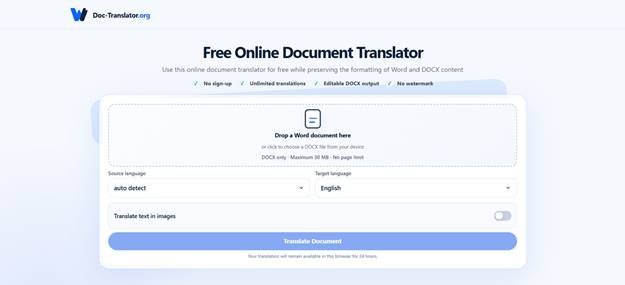
The service aims to retain elements such as paragraphs, tables, images, fonts, basic character styles, page dimensions, margins, lists, headers and footers. It accepts individual files of up to 30 MB and does not require registration.
Preserving the document structure can shorten the production process, although every translated file should still be reviewed. Longer text may alter line breaks, table dimensions and pagination even when the underlying formatting remains in place.
Separate Translation From Review
A finished translation still needs quality control. Assigning the review to a second person is ideal, especially for customer-facing or technical documents.
A practical review can be divided into three passes.
Language Review
Check whether the translation communicates the original meaning clearly. Pay particular attention to product terminology, industry phrases, instructions and warnings.
Automatic translation can handle many common sentences, but context remains important. A word that works in a marketing brochure may be inappropriate in a safety manual or legal notice.
Content Review
Confirm that names, dates, measurements, prices, URLs and model numbers match the source file. These details can be missed when reviewers focus mainly on grammar.
Also check whether every paragraph has been translated. Text inside tables, headers, footers and captions is easier to overlook than body copy.
Layout Review
Open the translated DOCX and inspect it page by page at its intended viewing size. Check both technical accuracy and visual rhythm:
- Missing characters or unexpected font fallback
- Inconsistent weights between Latin and non-Latin scripts
- Headings that wrap awkwardly or weaken the hierarchy
- Overly tight line spacing after font substitution
- Text cut off inside tables or text boxes
- Labels that collide with icons or images
- Lists with inconsistent indentation
- Captions separated from the correct images
- Headers, footers or page numbers that no longer fit
- Unbalanced pages created by text expansion
Review the document on screen and, when relevant, in a printed or PDF proof. A translation may be linguistically accurate while still requiring typographic adjustments before publication.
Create a Simple Naming System
Multilingual files need names that identify the language and version immediately. A consistent pattern might look like this:
- Employee_Handbook_EN_v2.docx
- Employee_Handbook_ES_v2.docx
- Employee_Handbook_FR_v2.docx
Use standard language codes and keep the same version number across translations produced from the same source. When the English master changes, create a new version and record which sections need to be translated again.
A small tracking sheet can list the document name, source version, target language, translator, reviewer and approval date. This provides enough visibility without introducing a complicated document management system.
Translate Updates Without Rebuilding Everything
Recurring documents create a different challenge. A company may update its price list every month or revise a product manual whenever a feature changes.
Keep a brief change log with the source document. It should explain which paragraphs, tables or pages were edited. Reviewers can then focus on the affected sections instead of comparing two entire files from the beginning.
Teams that need to translate DOCX online can use the updated source file to generate a new editable version, then apply the same language, content and layout checks. Keeping the master document clean makes each new translation cycle easier to manage.
Know When Professional Review Is Necessary
The level of review should reflect the purpose of the document. An internal meeting summary carries less risk than a medical instruction sheet, employment contract or regulatory filing.
Professional translators or subject specialists should review documents involving:
- Legal obligations
- Health or safety instructions
- Regulatory compliance
- Financial commitments
- Complex technical procedures
- Public claims about product performance
A fast translation workflow can support these projects, but specialist review remains essential when an error could cause financial, legal or physical harm.
Frequently Asked Questions
Can a translated DOCX be edited after download?
Yes. A translated document delivered in DOCX format can be opened and edited in compatible word-processing software. Teams can correct terminology, adjust layout and add internal notes before approval.
Will the translated document look exactly like the source?
The service aims to preserve the original structure and formatting. Differences in word length, sentence structure and writing direction can still affect spacing and pagination, so a visual review is recommended.
Should every employee be allowed to approve translations?
It is better to assign approval responsibility to a named person or role. This reduces conflicting edits and makes it clear which file is ready for distribution.
How should teams handle confidential documents?
Review the privacy and data-handling terms of any translation platform before uploading sensitive material. Legal, financial, medical and personally identifiable information may require an approved internal system or a vetted professional provider.
A Repeatable Process Saves Time
A dependable multilingual workflow does not need to be complicated. Start with one approved DOCX file, prepare its structure carefully, keep the translated output editable, and review both the language and layout.
Clear file names, assigned reviewers and a short change log prevent many of the problems that appear as a translation project grows. These habits help small teams create documents that remain useful across languages without turning every update into a new formatting project.
 Shaban Ch