

Every few years, cycling goes through a quiet material shift that changes what’s possible on a bike without most riders noticing it happen in real time. Steel gave way to aluminum. Aluminum gave way to carbon fiber. Within carbon fiber itself, fiber grades and layup techniques have kept advancing well past what “carbon” meant even a decade ago. None of these shifts arrived with fanfare — they showed up gradually, first in professional racing, then in flagship consumer products, and eventually as the new baseline expectation across the sport.
What’s easy to miss in that story is how much of modern cycling performance is really a materials science story wearing a bike-shaped costume. The frame geometry hasn’t changed dramatically in decades. The basic mechanics of a wheel — spokes under tension, a rim holding its shape, a hub spinning smoothly — haven’t changed either. What’s changed is what those components are made of, how precisely they can be engineered, and how confidently manufacturers can validate their performance before a rider ever throws a leg over the bike.
Why Material Choice Still Drives Most Performance Gains
It’s tempting to assume aerodynamics or component design account for most modern performance gains, but material choice remains the foundation underneath both. A frame or wheel’s shape can only be as ambitious as its material allows — carbon fiber’s ability to be molded into precise, aerodynamic profiles is what made a whole generation of aero road bikes and deep-section wheels possible in the first place. Aluminum, extruded and machined, simply can’t achieve the same shape flexibility.
This is also why fiber grade matters so much within carbon fiber itself. Higher-modulus fibers, generally labeled by designations like T700, T800, or T1100, offer meaningfully different strength-to-weight characteristics. A component built with a smarter combination of fiber grades — reinforcing high-stress zones with a stronger grade while using lighter fiber elsewhere — can outperform one built from a single uniform layup, even if both use “carbon” as a broad material description.
The Quiet Advances Happening in Resin Systems
Fiber grade gets most of the attention, but resin systems — the material binding carbon fibers together — have advanced substantially too. Better resin chemistry improves how consistently a carbon component holds its properties across temperature swings and repeated stress cycles, which matters directly for long-term durability. This is one of the less visible but genuinely important threads in modern carbon fiber engineering, and it’s part of why manufacturing consistency has improved industry-wide even as material costs have become more competitive.
Where Wheels Fit Into the Materials Story
Wheels are an unusually good showcase for material innovation because they combine so many competing demands in one component — light enough to help acceleration, stiff enough to transfer power efficiently, aerodynamic enough to matter at speed, and durable enough to survive years of real-world impact. Few other bike components have to balance quite so many trade-offs simultaneously, which is exactly why wheel engineering has become such a proving ground for new materials techniques.
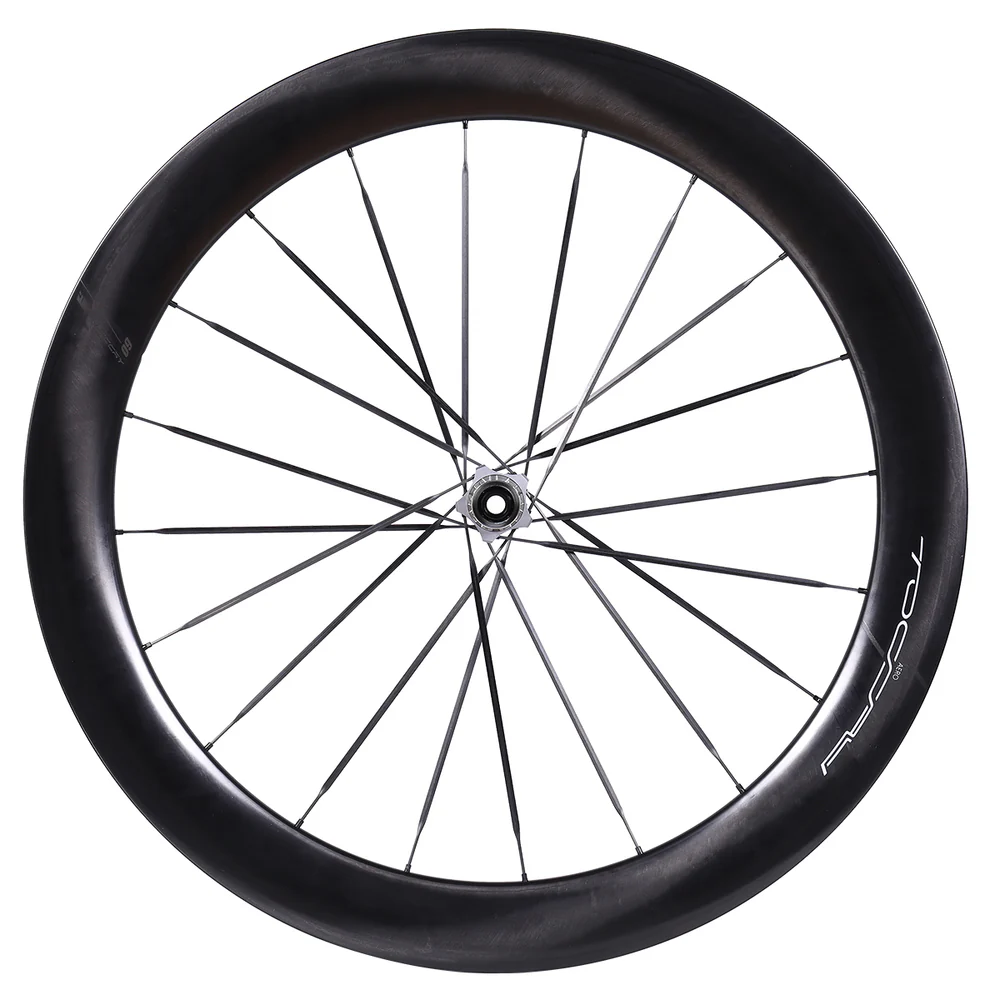
Spoke design is a particularly interesting piece of this. Historically, spokes were almost universally steel — reliable, well understood, and easy to manufacture consistently. Carbon spoke wheelsets represent a more recent shift, using carbon fiber spokes to reduce rotating weight further than steel spokes typically allow, while still meeting the tension and durability demands a spoke has to handle.
Why Spoke Material Choice Involves Real Trade-Offs
Carbon spokes aren’t a strictly superior replacement for steel — they’re a different set of trade-offs. Lighter rotating weight can improve acceleration feel, but spoke tension, lacing pattern, and overall wheel build quality all interact with spoke material to determine real-world ride feel and durability. A well-built wheel with either spoke type can perform excellently; the right choice depends on priorities like weight sensitivity versus long-term serviceability and cost.
Testing Has Advanced Alongside the Materials Themselves
Material innovation only matters if it can be validated, and testing methodology has matured right alongside the materials being tested. Impact testing — measuring how much force a rim or spoke system can absorb before failure — and spoke-hole pull-force testing, which measures how much tension the most stressed part of a wheel can withstand, give engineers concrete, repeatable numbers rather than relying on generalized durability assumptions.
This matters for riders too, not just engineers. A rider comparing wheelsets today can reasonably expect to see published test figures — impact-test joule ratings, pull-force kgf numbers, specific fiber grade callouts — rather than vague marketing language about strength and performance. That said, it’s worth remembering that internal testing, however rigorous, reflects a manufacturer validating its own product against its own defined standard, which is meaningfully useful information but distinct from independent third-party certification unless a brand states that explicitly.
Simulation Tools Have Shortened the Innovation Cycle
Finite element analysis and other simulation software let engineers model how a new spoke design or rim layup will behave under load before a physical prototype exists. This has meaningfully shortened development cycles across the industry, letting manufacturers iterate digitally and validate only the strongest candidate designs through physical testing, rather than building and destroying dozens of prototypes by hand. For riders, the practical result is faster access to genuinely improved components, since brands aren’t limited purely by how many physical prototypes their budget allows.
A Practical Look at Carbon Spoke Engineering Today
Seeing how these material advances show up in an actual product line helps ground the broader trend. TOCCAY’s carbon spoke wheelset lineup spans 40mm, 50mm, and 60mm rim depths, each built around a Toray T1100 or T800 + T1100 carbon layup depending on the specific model, paired with carbon fiber spokes, a 25mm inner / 33mm outer rim width, and a 36T ratchet hub system with sealed bearings. Wheelset weights across the range fall roughly between 1080g and 1240g depending on depth, each backed by a 36-month limited warranty and supporting both Shimano HG and SRAM XDR freehub options. Having this kind of detailed, model-specific spec breakdown available directly on the product listings is itself a reflection of how far manufacturing transparency has come alongside the materials themselves — riders can compare fiber grade, weight, and rim geometry across depths in a way that simply wasn’t standard practice a decade ago.
What Riders Should Actually Look for in Material Claims
Not every “advanced carbon” claim represents the same level of actual engineering rigor. Riders evaluating a new wheelset or component should look past broad material buzzwords and check for specifics — named fiber grades, documented test figures, and clear explanations of what those figures actually measure. A brand willing to publish granular detail, model by model, is generally signaling genuine confidence in its engineering rather than leaning on material innovation as a marketing shorthand.
It’s also worth remembering that material innovation isn’t a substitute for proper fit and compatibility. The most advanced carbon spoke wheelset in the world won’t perform well if it’s mismatched to your axle standard, rotor interface, or freehub body — material quality and compatibility are separate checks, and both deserve attention before a purchase.
The Materials Are the Story, Even When They’re Invisible
Modern cycling performance owes more to quiet material science advances than most riders realize day to day. Fiber grade selection, resin system improvements, and increasingly rigorous testing methodology are the real engine behind lighter, stronger, more precisely engineered components — wheels very much included. None of it is as visually exciting as a new aero shape or paint job, but it’s the foundation everything else is built on.
For riders evaluating new gear, the smartest approach is to look past marketing language and toward the specifics: named fiber grades, documented test data, and honest explanations of what those numbers represent. That’s where the real material innovation shows up — not in the adjectives on a product page, but in the engineering decisions that were actually made before the product ever reached the shelf.
 Shaban Ch