

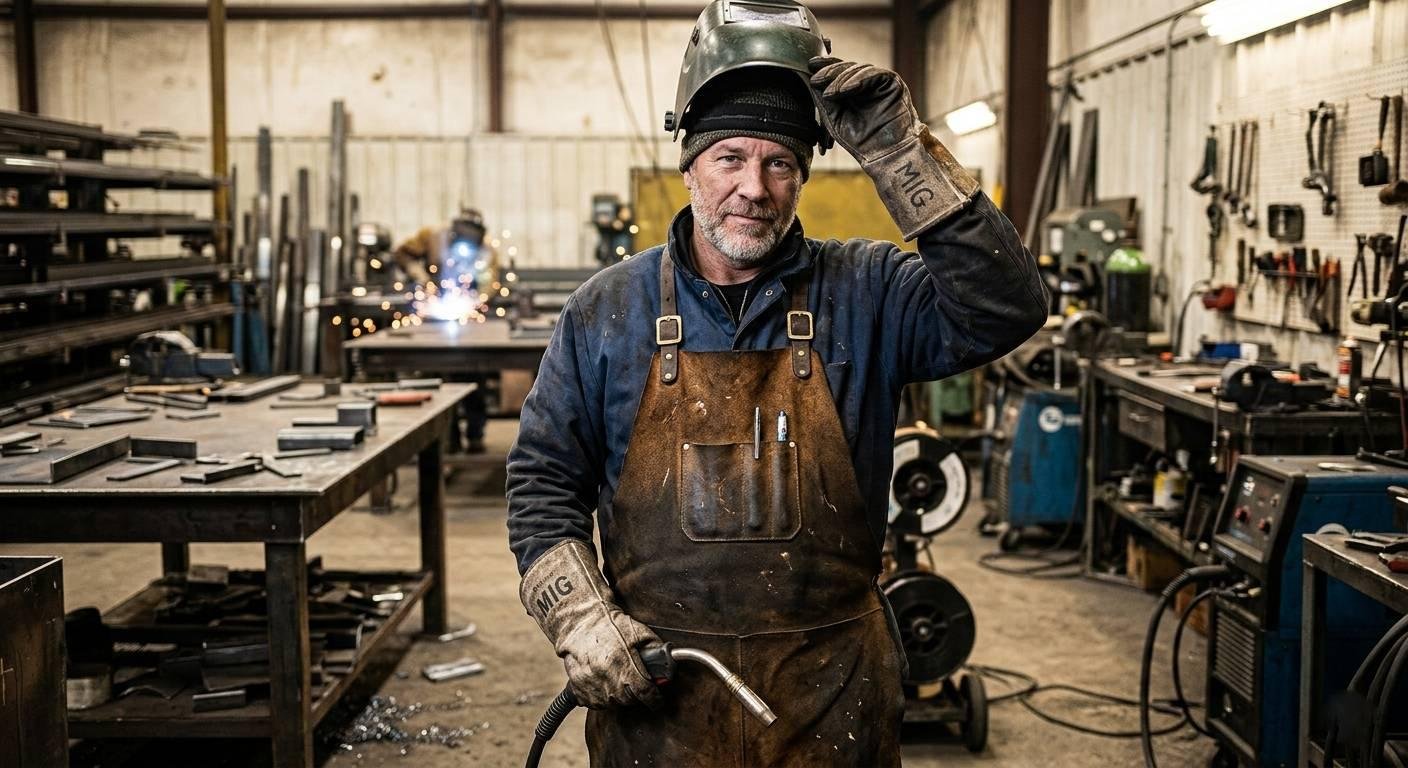
Welding gear conversations usually focus on helmets, gloves, jackets, sleeves, hoods, and boots. Those items deserve attention, of course. They protect the most obvious danger points: the eyes, hands, arms, face, and feet.
A welding apron does more than protect your clothes. During cutting, grinding, stick welding, MIG work, TIG work, bench fabrication, or ground-level welding, the apron takes constant abuse from sparks, slag, heat, sharp edges, and abrasive surfaces. It protects the front of the body in places where jackets, gloves, and sleeves may not give full coverage.
A good apron may not be the most exciting piece of gear in the shop, but when it fails, you notice quickly.
What a Welding Apron Actually Does
A welding apron is part of a complete PPE setup. It should not replace a proper welding jacket, gloves, helmet, sleeves, boots, or safe work practices. However, it adds an important layer of protection, especially during long shop shifts or jobs where sparks and hot debris travel downward.
A well-made leather welding apron helps with:
- spark resistance
- slag protection
- abrasion resistance
- protection from sharp metal edges
- clothing protection
- comfort during repeated bench or table work
- added coverage during grinding and fabrication tasks
Many welders do not fully appreciate the difference between a basic apron and a properly built one until they upgrade. A cheap apron may look similar at first glance, but the difference becomes clear after months of use.
The leather quality, thickness, stitching, hardware, strap design, and coverage all affect how the apron performs in real shop conditions.
The Three Common Types of Welding Aprons
Most welders end up using one of three common apron types.
1. Cheap Split-Leather Aprons
These are usually the entry-level options. They are affordable and often look tough enough for welding work. For light or occasional use, they may be acceptable.
The problem appears with regular use. Lower-cost split-leather aprons can become stiff, cracked, burned, or weakened over time. Stitching may fail, straps may stretch, and thin areas may wear through faster than expected.
They are not always bad, but they are usually not the best long-term option for full-time welders.
2. Canvas or Shop-Issued Aprons
Some shops provide basic canvas aprons. These may be useful for light-duty tasks, but they usually offer limited protection against hot sparks and slag.
Canvas can catch sparks instead of helping them roll away. It may also wear quickly in areas that rub against workbenches, sharp edges, or rough steel.
For welding, grinding, and fabrication work, canvas is usually less dependable than leather.
3. Full-Grain Leather Welding Aprons
A high-quality full-grain leather apron is the option many experienced welders eventually move toward.
It costs more upfront, but it usually offers better durability, stronger protection, and a longer useful life. With proper care, a well-built leather apron can last many years. Some welders use the same apron for a decade or more.
This is why the cheaper option is not always cheaper in the long run. If an apron needs to be replaced again and again, the cost adds up.
Why Spark Resistance Matters
When welders talk about PPE, they often focus on heat resistance and durability. Spark resistance does not always get the same attention, but it matters.
Welding sparks are small, hot, and unpredictable. They land on clothing, leather, pockets, seams, straps, and exposed surfaces. Whether they bounce off or stay in place can make a real difference.
Several details affect spark resistance.
Surface Texture
A smoother leather surface helps sparks roll off more easily. Rougher surfaces can catch sparks, dust, and metal particles.
Over a full shift, this matters. A spark that slides away quickly is less likely to cause damage than one that stays trapped in one place.
Leather Thickness
Thin materials give heat less time to disperse before it reaches the body. For welding aprons, thicker leather generally provides better protection and durability.
Many professional leather welding aprons use leather in the range of roughly 2.5 to 3.0 mm, depending on the design and intended use.
Hardware Quality
Plastic hardware, synthetic straps, and weak buckles can become a problem around sparks and heat. Solid metal hardware and leather straps are usually more dependable in welding environments.
Brass hardware is often preferred because it resists corrosion and handles demanding shop conditions well.
Coverage and Fit
Even a good apron can fail if it fits poorly. Gaps at the chest, sides, or waist can allow sparks to reach clothing or skin.
A proper welding apron should cover the front of the torso well and sit securely without restricting movement.
The Slag Problem
Slag creates a different challenge from ordinary sparks.
Sparks usually cool quickly. Slag can land hotter, stay hot longer, and stick to surfaces. If it catches in stitching, pockets, folds, or rough material, it can burn through fabric or damage the apron.
A good welding apron should help slag slide away instead of trapping it.
Aprons that handle slag better usually have:
- a smooth front surface
- enough leather thickness to slow heat transfer
- minimal exposed stitching on the front
- strong seams placed away from high-impact areas
- good lower-body coverage for seated or ground-level work
For welders who often work close to the floor, a split-leg or longer apron can be useful. This helps protect the thighs and shins when sparks and slag fall downward.
Why Better Welding Aprons Last Longer
A quality welding apron lasts longer because it is built for repeated abuse.
The main advantage is not only the leather itself. The construction matters just as much.
A durable welding apron usually has strong stitching, reinforced stress points, dependable straps, solid hardware, and a design that avoids unnecessary weak spots.
Full-grain leather also handles shop wear better than many cheaper materials. Sparks may mark the surface, but surface marks do not always mean the apron has lost its usefulness.
Another advantage is repairability. Good leather gear can often be repaired instead of replaced. Stitching can be redone. Buckles and rivets can be replaced. Leather can be cleaned and conditioned.
That is one reason many welders see a good apron as a long-term investment rather than a disposable item.
How to Care for a Leather Welding Apron
Many welders replace aprons earlier than necessary because they do not maintain them.
Leather welding aprons do not need complicated care, but they do need basic attention. Dirt, metal dust, slag, oil, moisture, and repeated heat exposure can all shorten the life of the apron.
A simple care routine helps:
- Brush off slag, dust, and metal particles after use.
- Check for hot debris before storing the apron.
- Wipe the surface with a slightly damp cloth when needed.
- Avoid soaking the leather.
- Let the apron dry naturally if it becomes damp.
- Hang it instead of folding it.
- Inspect straps, stitching, rivets, and pockets regularly.
- Condition the leather occasionally to prevent dryness and cracking.
There’s a longer treatment of leather apron care, including welding-specific scenarios, in this leather apron protection and care guide. The general principle is that proper care doubles or triples the apron’s service life. Welders who follow basic care routines get 15 to 20 years out of an apron. Welders who neglect them get 3 to 5.
Common Welding Apron Mistakes
Many apron problems come from buying the wrong apron, using it incorrectly, or waiting too long to replace it.
Buying Based on Appearance
Some aprons look tough in photos, but are not built for demanding welding work. Before buying, look beyond the appearance.
Check the leather type, thickness, stitching, strap design, hardware, and coverage.
A good apron should be judged by specifications, not just style.
Choosing Poor Coverage
Short aprons may be comfortable, but they may not protect enough of the body during grinding, bench work, or overhead spark exposure.
For many welding tasks, coverage from the chest to at least the knees is useful. For ground-level work, longer coverage may be better.
Ignoring Failed Stitching or Hardware
An apron with torn straps, failed stitching, broken buckles, or burn-through spots should not be ignored.
A welding apron is PPE. Once it is damaged to the point that it reduces protection, it should be repaired or replaced.
Skipping the Apron Entirely
Some welders rely only on jackets or heavy clothing. That may be enough for short, light jobs, but it is not ideal for sustained welding or fabrication work.
The apron protects areas that often take direct hits from sparks, slag, grinding debris, and sharp workpieces.
What to Look for in a Good Welding Apron
When choosing a welding apron, look for practical features rather than marketing claims.
A strong welding apron should include:
- full-grain leather or another welding-suitable leather
- enough thickness for spark and abrasion resistance
- a smooth front surface
- strong stitching
- reinforced stress points
- durable metal hardware
- secure adjustable straps
- comfortable weight distribution
- good chest-to-leg coverage
- minimal front-facing weak points
- pockets only where they are useful and safe
- a design that suits your welding position and work style
Cross-back straps are often more comfortable than simple neck straps because they distribute weight across the shoulders and back. This matters during long shifts.
Pockets can be useful, but they should not become spark traps. If the apron has pockets, they should be positioned carefully and reinforced properly.
Is a Premium Leather Welding Apron Worth It?
For occasional welding, a basic apron may be enough. Not everyone needs the most expensive option.
But for regular welding, fabrication, grinding, metalworking, blacksmithing, or shop use, a better apron is usually worth considering.
The value comes from:
- longer service life
- better comfort
- stronger protection
- fewer replacements
- better resistance to shop abuse
- improved fit and coverage
The upfront cost may be higher, but the cost per year of use can be lower if the apron lasts significantly longer.
For working welders, that matters.
Final Thoughts
A welding apron is not the most talked-about piece of PPE, but it does important work every day.
It takes spark hits. It blocks slag. It protects clothing and skin. It reduces wear during bench work. It adds another layer of safety during long, demanding jobs.
The best apron is not always the one that looks the toughest. It is the one built with the right leather, proper thickness, strong hardware, secure stitching, good coverage, and a practical design for real welding conditions.
For welders who spend serious time in the shop, the apron should not be an afterthought. Choose the right one, take care of it, inspect it regularly, and replace or repair it when it no longer protects properly.
A good welding apron may not get much attention, but it earns its place every time sparks start flying.