

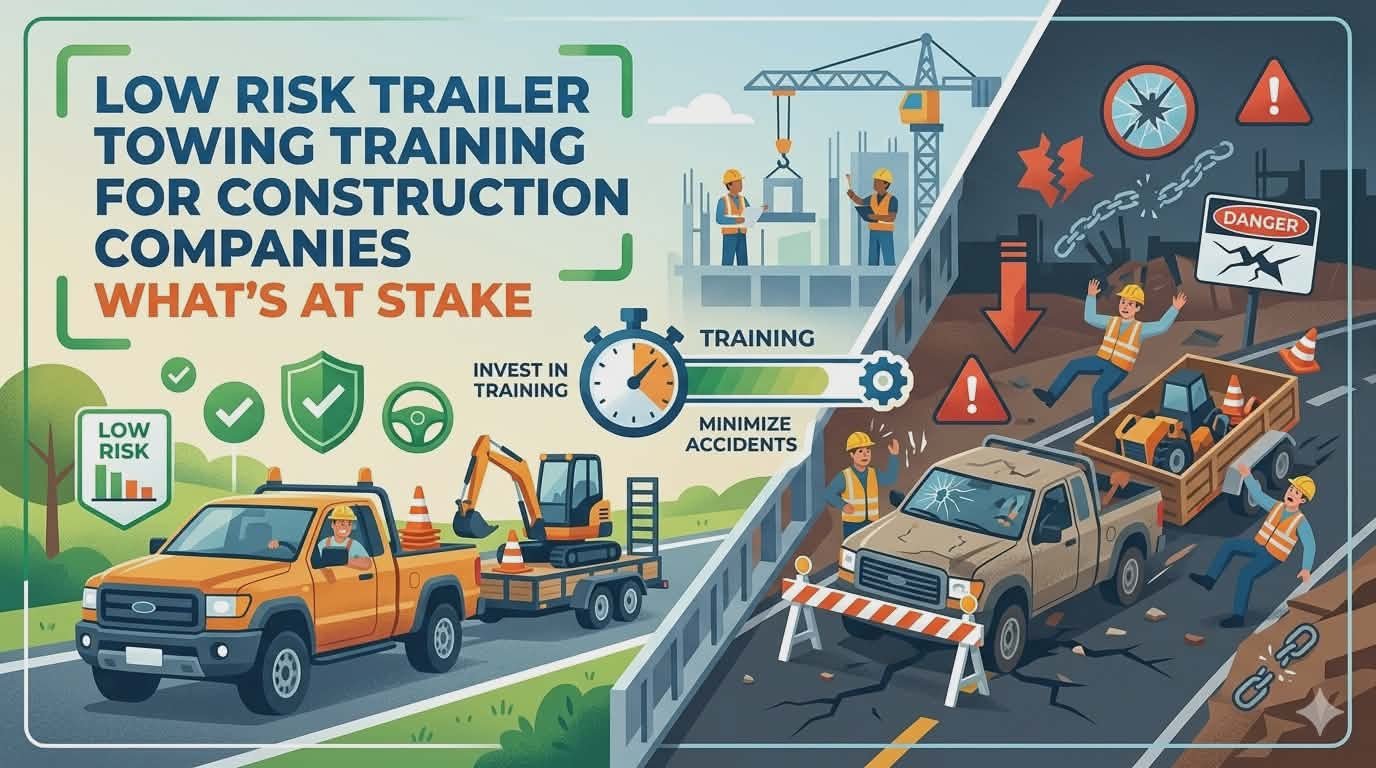
What’s the Article Talking About? Trailer towing is a common task in construction operations, but it comes with significant safety risks if drivers are not properly trained. Know how a professional trailer towing course helps drivers understand vehicle control, load distribution, and safe towing practices.
Talking about the construction industry, it is an inevitable fact that such companies that come under the operations look out for vehicles that can carry heavy loads of tools, machinery, materials, and equipment. Trailer towing refers to the practice of carrying weight from one site to another. While it might appear as everyday work, the practice has its own risk factors that can significantly affect safety considerations. Improper towing leads to accidents, damage, costly delays, and, sometimes, legal issues. For this, companies investing in a trailer towing course are becoming the new normal.
A systematic towing course, like that of Corporate Driver Training Australia, provides a framework that not only clears the obstacle in driving the trailers seamlessly but also perfects any abnormal situation that appears instantly. Let’s take a deep dive into why, what, and how to make sure that your company’s trailer towing continues as smoothly as butter.
Why Trailer Towing Risks Are High In The Construction Industry
It’s not new that a construction site is found in an accident due to swaying trailer driving or heavy-load pressure. The construction operations require vehicles to frequently travel between sites with loads of machinery, equipment, or any other type of building materials. If a driver is not equipped with proper knowledge about the operations of trailers, it will definitely lead to accidents or other hazards. This includes poor load balance, braking challenges, and reduced vehicle control.
For the companies involved with the construction spectrum, such an accident can lead to delays, which can further lead to sour relationships and trust issues in the business. A professional towing course prepares drivers mentally and physically to handle challenges safely and confidently.
The Financial And Legal Risks Of Skipping A Towing Course
Failing to carry a trailer properly will lead to problems for the companies. Not only will it be an internal problem, but in some places it can result in financial and liability claims that can move up to legal notices and hefty penalties.
- Accident which occurs due to improper towing
- Exceeding towing limits
- Failing to secure loads and disbalancing
The above-mentioned issues can result in road hazards, damage to third-party property and vehicles, or equipment loss (financially). Enrolling drivers in a proper trailer towing course will result in commitment to safety and compliance. It also helps organisations create clear towing procedures and reduce operational risks.
How Well Will A Towing Course Improve Drivers’ Cognisance?
When it comes down to handling such a responsibility, the trailer towing course is the one that imparts the knowledge and awareness that is required to handle a trailer carefully. CDTA’s training programme teaches participants about how towing affects vehicle dynamics and what precautions need to be taken before and during their travel.
Drivers get along with the practical skills, such as the following:
- Understanding trailer weight limits
- Hitching and Unhitching Procedures
- Correct load distribution techniques
- Safe braking and acceleration, as per the situations
- Managing trailer sway
- Safe reversing with a trailer attached
- Other safety checks
These skills are important to learn, as trailer towing happens on these theories only. Once the driver’s driving foundation is strong, they can juggle through any situation they face bravely and confidently. An organised trailer towing course also includes other principles, which include awareness building and reducing towing-related incidents.
Why Are Caravan Towing Courses Important For The Companies?
Now there is a stark difference between a normal trailer towing and caravan towing. Caravan towing needs more practice, strength, and confidence, as caravans have increased weight, height, length, and wind resistance in comparison with trailers.
| BASIS OF DISTINCTION | TRAILER TOWING | CARAVAN TOWING |
| Purpose | It is mainly used for transporting equipment, tools, materials, or machinery for work purposes. | It is primarily used for leisure travel and accommodation during trips. |
| Trailer Structure | A trailer is usually an open or enclosed platform designed to carry cargo or equipment. | A caravan is a fully enclosed unit with living facilities like beds, a kitchen, and storage. |
| Weight Distribution | Load distribution depends on how the cargo is placed and secured on the trailer. | Weight is pre-structured but still requires careful balance for stability. |
| Driving Challenges | May involve irregular loads, shifting weight, and frequent loading or unloading. | Larger size and fixed structure require careful manoeuvring, especially during turns and parking. |
| Typical Users | Commonly used by construction companies, contractors, and businesses transporting goods. | Mostly used by travellers, campers, and holidaymakers for long road trips. |
A caravan towing course not only provides valuable insights into managing a large vehicle but also teaches about maintaining vehicle stability under different road conditions.
Building a Safer Work Culture Through a Trailer Towing Course
Safety is the key to everything. Even if it is a trip to a construction site, which might be merely half a kilometre, it is still important to be careful and safe along the way. To make sure that each of your employees is equipped with the knowledge that covers trailer towing, enrol in CDTA’s towing course, and ensure seamless travel throughout the journey.
By prioritising towing training, construction companies not only protect their drivers but also their reputation in the market, highlighting their work ethic within the spectrum. Therefore, towing training is not just an education; it is a step towards building a safe environment in the competitive ladder.