
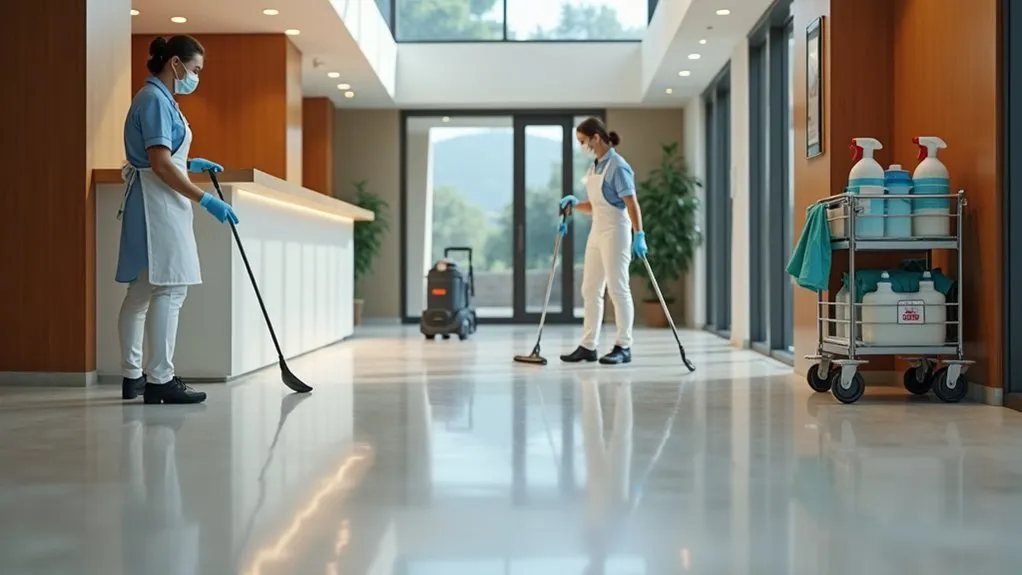
The expectations placed on commercial facility management have changed significantly in recent years. Where once routine cleaning was considered sufficient for most business environments, the demand for verifiable, high-standard disinfection has moved well beyond healthcare and into offices, logistics facilities, retail environments, and hospitality venues. Professional commercial disinfection services that deploy advanced methods are no longer a niche offering — they represent the emerging standard for businesses that take the health and safety of their people seriously.
This shift reflects a broader and well-founded recognition that surface contamination poses real operational risks. Illness spreading through a workforce costs productivity, disrupts operations, and in some environments creates liability exposure. The tools and methods now available to professional disinfection providers can address these risks with a precision and efficacy that traditional cleaning approaches simply cannot match.
Beyond Traditional Cleaning — What Advanced Disinfection Actually Means
Traditional cleaning removes visible dirt and reduces surface contamination, but it does not reliably eliminate the full spectrum of pathogens that can persist on commercial surfaces. Advanced disinfection methods are designed to do exactly that — targeting bacteria, viruses, fungi, and spores with validated efficacy across a comprehensive range of surface types and environments.
The distinction matters because the pathogens responsible for the most disruptive workplace illnesses — influenza, norovirus, respiratory viruses, and drug-resistant bacteria — are not reliably addressed by standard cleaning protocols alone. A disinfection programme that deploys the right agents at the right concentrations, with appropriate dwell times and correct application methods, achieves a measurably different outcome from one that does not.
For businesses where operational continuity is critical — distribution centres, call centres, food production facilities, financial trading floors — the difference between a contained illness event and a workforce-wide disruption can come down to the quality of the disinfection programme in place.
Electrostatic Spraying Technology
Electrostatic spraying has emerged as one of the most effective technologies for large-scale surface disinfection in commercial environments. The technology works by applying an electrical charge to disinfectant droplets as they leave the sprayer, causing them to be attracted to and wrap around surfaces — including the undersides and backs of objects that traditional spray-and-wipe methods cannot reach effectively.
The result is a more uniform and comprehensive coverage of treated surfaces, achieved more rapidly and with less product than conventional application methods. For large open-plan offices, warehouses, vehicle fleets, or event venues, electrostatic spraying enables thorough disinfection of entire environments in timeframes that would be impossible to achieve manually.
When combined with an EPA-registered disinfectant with proven efficacy against the target pathogens, electrostatic spraying delivers a verifiable standard of surface disinfection that traditional methods cannot replicate.
Ultraviolet-C Disinfection
Ultraviolet-C light technology has a well-established evidence base in healthcare settings and is increasingly being deployed in commercial environments as a supplementary disinfection measure. UV-C light at the appropriate wavelength damages the DNA and RNA of microbial organisms, rendering them unable to replicate and effectively eliminating them from treated surfaces and air.
Mobile UV-C units can be deployed in rooms, vehicles, and enclosed spaces after manual cleaning, providing an additional layer of disinfection assurance that is particularly valuable in high-risk or high-value environments. While UV-C technology requires appropriate safety protocols — it must not be used in occupied spaces — it represents a powerful tool in the advanced disinfection toolkit when deployed correctly by trained professionals.
Fogging and Vapour-Phase Disinfection
Fogging systems disperse disinfectant as a fine mist that penetrates areas inaccessible to manual cleaning — inside air handling systems, within complex equipment, and across large three-dimensional spaces. Hydrogen peroxide vapour systems, in particular, have demonstrated broad-spectrum efficacy against a wide range of pathogens and are used extensively in pharmaceutical manufacturing, food processing, and healthcare environments where the highest disinfection standards are required.
For commercial spaces recovering from a confirmed illness outbreak, or for environments that require periodic deep disinfection as part of a preventative programme, fogging provides a comprehensive treatment option that manual methods alone cannot deliver. The selection of the appropriate fogging agent and concentration is critical — this is not a process that should be entrusted to providers without specific training and experience in vapour-phase disinfection.
Documentation, Verification, and Accountability
One of the defining characteristics of a professional advanced disinfection programme is its commitment to verification and documentation. ATP testing — which measures the presence of adenosine triphosphate as a proxy for biological contamination — provides an objective, quantifiable measure of surface cleanliness before and after disinfection. Environmental sampling can identify the presence of specific pathogens and confirm their elimination following treatment.
These verification tools transform disinfection from a process that must be taken on trust into one that can be objectively measured and reported. For businesses with regulatory obligations, for organisations that have experienced illness events, or for any commercial operator that wants genuine confidence in the standard of their disinfection programme, this level of accountability is increasingly expected — and should be demanded from any provider claiming to deliver advanced disinfection services.
Integrating Advanced Disinfection Into Ongoing Facility Management
Advanced disinfection is most effective when it is integrated into a broader facility management programme rather than deployed reactively in response to illness events. A structured approach — combining routine professional cleaning with scheduled disinfection interventions calibrated to the risk profile of the environment — provides continuous protection rather than periodic remediation. For commercial operators committed to the health of their workforce and the continuity of their operations, professional sanitizing and disinfecting service delivered to this standard represents one of the most tangible investments available in the resilience of their business.
 hamza seo
  Shaban Ch