

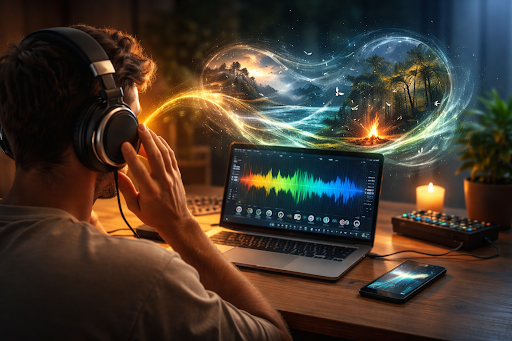
In the evolving landscape of digital storytelling, audio is no longer an afterthought—it is the emotional backbone of immersive experiences. From podcasts and audiobooks to cinematic trailers and interactive brand campaigns, sound design shapes how audiences feel, remember, and engage. Today, advances in artificial intelligence are redefining how creators approach audio production. Instead of relying solely on traditional recording studios and complex editing workflows, storytellers can now convert written ideas directly into expressive soundscapes.
One of the most promising innovations in this space is the emergence of intelligent text-to-audio systems that transform scripts into layered sound environments, complete with voice, music, and ambient textures. Among these, minimax ai is rapidly gaining attention for its ability to generate high-quality audio and music directly from text prompts—opening new doors for immersive storytelling at scale.
The Rise of AI-Driven Audio Storytelling
Storytelling has always evolved alongside technology. The printing press expanded literature. Film introduced synchronized sound. Streaming democratized content distribution. Now, artificial intelligence is reshaping how stories are produced in the first place.
Modern audiences expect multi-sensory engagement. A static script is no longer enough—listeners want cinematic narration, emotional music, and realistic background effects. However, producing such layered audio traditionally required:
- Professional voice actors
- Music composers
- Sound designers
- Studio-grade recording environments
- Advanced editing software
These requirements often placed immersive storytelling out of reach for independent creators, educators, marketers, and small production teams. AI-driven text-to-audio tools are changing that equation by collapsing production time and cost while preserving creative flexibility.
Turning Text into Emotion-Rich Sound
At its core, text-to-audio technology interprets written language and translates it into spoken narration, background music, or environmental sounds. But the most advanced systems go beyond simple text-to-speech. They understand tone, pacing, context, and narrative structure.
This is where minimax ai stands out. It allows creators to transform text into dynamic audio compositions, blending expressive voice synthesis with AI-generated music. Rather than producing flat, robotic narration, it generates immersive soundscapes tailored to the mood and intention of the script.
For example:
- A suspenseful thriller script can be paired with tense atmospheric music and subtle ambient effects.
- A children’s bedtime story can feature warm narration with gentle instrumental layers.
- A product launch script can be enhanced with energetic beats and confident voice tones.
By intelligently aligning voice and music, the technology enables storytellers to focus on narrative craft while automation handles the complexity of sound production.
Professional Integration Within a Broader Creative Ecosystem
Importantly, minimax ai is now available within invideo, providing creators with a streamlined workflow that integrates audio generation directly into a larger content creation environment. Through this integration, users can convert text into expressive audio and music without switching between multiple platforms, maintaining creative continuity from script to final output.
This development is significant because it eliminates friction in the storytelling pipeline. Creators can manage the entire process cohesively, eliminating the need to export scripts to one system, generate voiceovers in another, and source music elsewhere. The result is greater efficiency, faster turnaround times, and consistent production quality.
Beyond Voiceovers: Building Complete Soundscapes
Immersive storytelling requires more than narration alone. The emotional impact of a story often depends on subtle elements:
- Background ambiance
- Musical transitions
- Emotional crescendos
- Pauses and pacing
AI-generated soundscapes can automatically adapt to narrative arcs. For instance, a travel documentary script can gradually shift its musical energy as the journey progresses, while a motivational speech can build toward an inspiring crescendo.
Such capabilities redefine what “audio production” means. Instead of manually layering tracks, creators can describe the mood and structure in text form and allow intelligent systems to compose matching audio environments.
This is particularly powerful for:
- Podcast producers seeking scalable workflows
- E-learning platforms requiring consistent narration styles
- Marketing teams producing multiple campaign variations
- Indie game developers designing atmospheric audio
Enhancing Audience Engagement Through Personalization
One of the most exciting aspects of AI-generated audio is personalization. Since sound can be dynamically generated from text, content variations become easier to produce.
Imagine:
- Multiple narration styles tailored to different audience segments
- Localized accents and language adaptations
- Custom background music aligned with regional preferences
- Personalized storytelling experiences for interactive applications
Because audio is generated algorithmically, creators can iterate rapidly. This opens opportunities for hyper-personalized campaigns, adaptive learning modules, and immersive brand storytelling.
As personalization becomes central to digital strategy, scalable text-to-audio tools will play a foundational role.
The Broader Impact on Video Storytelling
Audio and video are inseparable in modern media. While intelligent sound design enhances narrative immersion, visual elements complete the experience. Platforms like invideo not only integrate advanced audio capabilities but also offer an ai video generator, enabling creators to transform scripts into complete multimedia productions.
This dual capability—combining AI-powered soundscapes with automated video generation—represents a shift toward unified content creation. Instead of managing audio and visuals separately, storytellers can conceptualize entire experiences from a single script.
Such integration reduces production bottlenecks and empowers creators to experiment more freely. A marketer can test multiple narrative angles. An educator can repurpose written lessons into both audio modules and visual explainers. A brand can maintain a consistent tone across formats.
Creative Freedom Without Technical Barriers
Traditional audio engineering demands technical knowledge: equalization, mixing levels, compression, and and mastering. While these skills remain valuable, not every storyteller wants to become a sound engineer.
AI-driven systems abstract much of this complexity. Creators describe what they want emotionally—“dramatic,” “uplifting,” “calm,” “mysterious”—and the system interprets those cues musically and vocally.
This democratization mirrors what happened in graphic design and video editing. As tools become more intuitive, creative expression becomes more accessible.
However, accessibility does not mean compromise. Advanced AI models are trained on vast datasets to ensure natural prosody, realistic tonal shifts, and musically coherent compositions. The result is production-ready output that meets professional standards.
Use Cases Across Industries
The applications of intelligent sound generation extend across industries:
1. Publishing and Audiobooks
Authors can convert manuscripts into expressive audio editions without coordinating studio sessions.
2. Education and E-Learning
Teachers can transform lesson plans into narrated modules with thematic music that reinforces retention.
3. Marketing and Advertising
Brands can produce high-impact promotional audio that aligns with campaign messaging and emotional tone.
4. Gaming and Interactive Media
Developers can generate adaptive background music that responds to gameplay scenarios.
5. Podcasting and Content Creation
Creators can streamline episode production, reducing editing time while enhancing sound quality.
In each case, AI reduces friction between idea and execution.
The Emotional Science Behind Immersive Audio
Research consistently shows that sound significantly influences emotional perception. Music can trigger memory recall, alter mood, and increase message retention. Tone of voice affects trust and credibility. Ambient sounds create context.
By automating the translation of textual intent into auditory experience, AI-driven text-to-audio systems bridge the gap between intellectual narrative and emotional resonance.
Instead of treating audio as a finishing touch, creators can now design it as a core storytelling component from the outset.
Future Trends in Text-to-Audio Innovation
As artificial intelligence continues to evolve, we can expect even more sophisticated capabilities:
- Real-time adaptive soundscapes
- Emotionally responsive narration
- Multilingual voice synthesis with cultural nuance
- Integration with augmented and virtual reality environments
The convergence of AI-generated audio and immersive technologies will likely define the next era of storytelling.
Moreover, as data-driven insights refine personalization, audio experiences may become increasingly interactive—adjusting tone, pacing, and music based on user engagement signals.
Redefining the Creative Workflow
The traditional content pipeline often involved multiple disconnected stages: writing, recording, editing, scoring, mixing. AI integration consolidates these steps into a cohesive process.
By embedding advanced text-to-audio capabilities within broader creative platforms, storytellers can ideate, generate, refine, and publish from a single environment. This shift encourages experimentation and iteration, which are essential for innovation.
More importantly, it levels the playing field. Independent creators can now access tools that rival studio-level production.
A New Era of Immersive Narratives
The transformation of text into layered, emotionally rich audio marks a turning point in digital storytelling. Intelligent sound generation enables creators to translate imagination directly into immersive auditory experiences—without technical complexity or prohibitive costs.
As AI continues to blur the boundaries between writing, music composition, and sound design, storytelling becomes more fluid, accessible, and dynamic. For creators seeking to craft deeper emotional connections with their audiences, personalized soundscapes represent not just a trend, but a fundamental evolution in how stories are told and experienced.